 Ghost Tour Prague
Haunted Places in Prague
The haunted places in Prague are real squares, lanes and churches that carry legends you can walk to in an evening. Twenty-seven crosses set into the pavement of Old Town Square mark the spot where Bohemian nobles were beheaded in 1621, and a mummified forearm hangs inside the Church of St James. This guide lists the places area by area: what the story says, what you actually see today, what it costs to enter, and which bookable ghost tour passes each one on its route. Nothing here claims a ghost is real. The legends are told as legends, the admission fees come from official listings, and the tour links go to pages where you can check times and prices yourself. The bookable tours are compared on ghost tour in Prague.
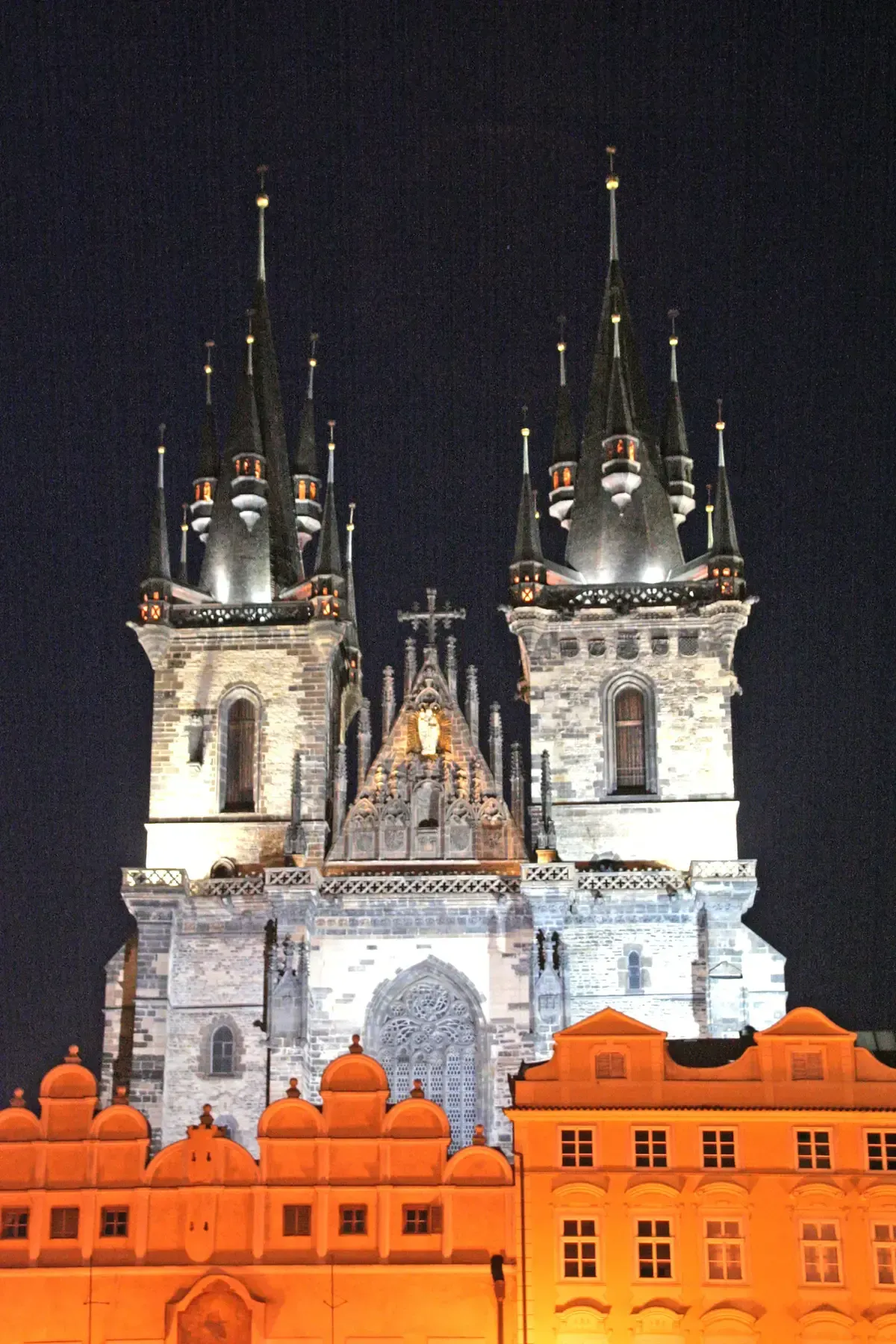
Týn Church at night. Photo: Tony Hisgett, CC BY 2.0, via Wikimedia Commons
Quick answer Is Prague haunted?
Yes in one sense: Prague is a city of ghost legends tied to real, findable places, starting with the 27 crosses in Old Town Square that mark where 27 nobles were beheaded in 1621. No verified ghost has ever been recorded at any of them. What you get instead is a compact walkable map of execution sites, cursed houses and one very strange mummified arm. Most of the places are free to see from the street, and several night tours thread them together after dark.
Key takeaways
- See the list area by area, starting with the Old Town and Josefov.
- A costumed storyteller walk through the Old Town and Jewish Quarter is the Prague Ghosts and Legends Nighttime Guided Walking Tour, $21 for 100 minutes to 2 hours.
- For the Golem story in full, read the Golem of Prague guide, and for gravestones and layers, the Old Jewish Cemetery guide.
- If you want to go under the city rather than along it, the lantern underground and dungeon tour at $30.92 at $30.92 at $30.92 adds a dungeon and an alchemy laboratory to the ghost walk.
Haunted Places in Prague on One Map
Every pin is a place tied to a Prague legend. Bubbles are sized by how many of the ghost tours compared on this site pass it, and grey dots are places you see on your own.
-
Old Town Square and the 27 crosses
5 of the toursCrosses in the pavement mark the 27 men executed in 1621.
Stops here: Prague Ghosts and Legends Nighttime Guided Walking Tour, Prague Ghost Walking Tour Where Legends Come To Life, Prague Ghost Tour with a Costumed Storyteller, Prague Plague Doctor Old Town History Walking Tour, Medieval Prague Through a Nightwatchman's Eyes
-
Astronomical Clock
2 of the toursThe legend of master Hanuš, blinded so he could not build a second clock.
Stops here: Prague Ghost Walking Tour Where Legends Come To Life, Prague Ghost Tour with a Costumed Storyteller
-
Church of Our Lady before Týn
2 of the toursTycho Brahe is buried inside.
Stops here: Prague Ghosts and Legends Nighttime Guided Walking Tour, Prague Ghosts and Legends of the Old Town Evening Tour
-
Ungelt (Týn Court)
1 of the toursThe medieval merchants' yard behind Týn Church.
Stops here: Prague Ghosts and Legends Nighttime Guided Walking Tour
-
Kinský Palace
No tourSaid to be haunted by a girl in white who asks for help for her father.
No guided tour stops here. Self-drive only.
-
The Iron Man
No tourAn iron knight freed only once a century. Location approximate, the versions place him differently.
No guided tour stops here. Self-drive only.
-
The headless Templar
No tourA headless knight on a flaming horse. Location approximate, the versions differ.
No guided tour stops here. Self-drive only.
-
Old New Synagogue
2 of the toursThe legend places the Golem in its attic, which is closed to the public.
Stops here: Prague Ghosts and Legends Nighttime Guided Walking Tour, Prague Ghost Tour with a Costumed Storyteller
-
Old Jewish Cemetery
2 of the toursRabbi Loew's grave among layered burials.
Stops here: Prague Ghosts and Legends Nighttime Guided Walking Tour, Prague Ghost Tour with a Costumed Storyteller
-
Speculum Alchemiae
No tourA Rudolfine alchemy workshop found under a house on Haštalská.
No guided tour stops here. Self-drive only.
-
Charles Bridge
3 of the toursJohn of Nepomuk and Bruncvík's sword.
Stops here: Prague Ghost Walking Tour Where Legends Come To Life, Medieval Prague Through a Nightwatchman's Eyes, Mysteries and Alchemy at Prague Castle Myths and Legends
-
Čertovka, Kampa
No tourThe Devil's Stream under Charles Bridge. Location approximate.
No guided tour stops here. Self-drive only.
-
Museum of Prague Ghosts and Legends
No tourA museum of the city's ghost stories on Mostecká.
No guided tour stops here. Self-drive only.
-
Museum of Alchemists and Magicians
1 of the toursSaid to be Edward Kelley's house.
Stops here: Prague Ghost Walking Tour Where Legends Come To Life
-
Golden Lane
1 of the toursThe alchemists' myth and the real residents of the castle lane.
Stops here: Alchemy and Mysteries of Prague Castle Walking Tour
-
Černín Palace
No tourCountess Černínová, who wore bread slippers in a famine, is said to haunt it.
No guided tour stops here. Self-drive only.
-
Faust House
No tourThe devil is said to have taken Faust through the ceiling. Edward Kelley lived here.
No guided tour stops here. Self-drive only.
-
Devil's Column
No tourA priest's wager with the devil, at Vyšehrad.
No guided tour stops here. Self-drive only.
Haunted Places in the Old Town
The stops here sit in and around Old Town Square and can be reached on foot.
Old Town Square and the 27 Crosses
In the pavement near the Old Town Hall, 27 crosses record the spot where 27 Bohemian nobles were executed after the Habsburg victory at the Battle of White Mountain in 1620. The executioner was Jan Mydlář. A plaque naming all 27 victims dates from 1911, and the crosses themselves were laid into the pavement during post-war repairs. Legend adds that the executed men haunt Charles Bridge, where their heads were once displayed. The crosses are free to see at any hour, and the square is the first stop on the route of the Prague Ghosts and Legends Nighttime Guided Walking Tour at $21 and on the nightwatchman walk from the Powder Tower at $27.49, which covers the 1621 executions.
Sources: Wikipedia on Old Town Square, expats.cz on Prague ghost stories
The Astronomical Clock
The Old Town Hall's Astronomical Clock is first recorded on 9 October 1410, built by clockmaker Mikuláš of Kadaň and the mathematician Jan Šindel. It is the third oldest astronomical clock in the world and the oldest still working. The dark legend belongs to the clockmaker Hanuš: the story says councillors had him blinded with a hot poker so he could never build a second clock, and that the blind master tore a vital part from the mechanism and died. Historians call this a misreading of the records and point to Jan Růže around 1490 as the likely source. The clock can be seen from the square. The Prague Ghost Walking Tour Where Legends Come To Life includes the clock for $26, and the costumed storyteller tour at $25 also lists it on its route.
Sources: Wikipedia on the Astronomical Clock
The Old Town Hall and Its Underground
The building that houses the clock also holds one of the strangest interiors in the Old Town. The cellars keep the layout of the original merchants' houses, with Gothic ribbed vaults from the 13th and 14th centuries and a Romanesque ground floor from about 1200. Tower admission is 350 CZK basic, 230 CZK reduced, 280 CZK for youth 16 to 26 and 750 CZK family, and guided tour surcharges are 150 CZK for the circuit covering chapel, state rooms and underground or 100 CZK for the underground alone. The hall is open 10:00 to 19:00 from January to March and 9:00 to 20:00 from April to December. The Prague Medieval Underground of the Old Town Hall Guided Tour at $28 includes entry to two undergrounds, the Old Town Hall underground and the Angels College underground.
Sources: prague.eu on the Old Town Hall
Týn Church and the Tomb of Tycho Brahe
The twin towers of Our Lady before Týn rise 80 metres over the square, and the southern tower was finished in 1511. Inside, at the first southern pillar of the nave, lies the tombstone of the astronomer Tycho Brahe, who died in Prague on 24 October 1601 aged 54. Kepler recorded that Tycho held back from leaving a banquet out of etiquette and died eleven days after urinary trouble began. Poisoning theories circulated, but Czech and Danish researchers working from 2010 to 2012 concluded the mercury levels were too low and murder was impossible. The church stands on the route of the Prague Ghosts and Legends Nighttime Guided Walking Tour at $21 and McGee's Old Town evening walk at $23.
Ungelt, the Týn Yard
Behind Týn Church sits the Ungelt, a medieval merchant courtyard with 18 historic houses, reopened to the public on 18 December 1996. Archaeology from the 1980s and 1990s dates the yard to the medieval period, and the Granovský Palace inside it was granted to customs officer Jakub Granovský by Ferdinand I in 1558. The story says a Turkish merchant engaged to a Czech girl returns to find her married to another, she vanishes and is found decapitated, and his ghost now offers passersby a look into a box that holds her head. It is a stop on the Prague Ghosts and Legends Nighttime Guided Walking Tour at $21.
Sources: prague.eu on the Týn Yard, expats.cz on Prague ghost stories
Kinský Palace and the Girl in White
On Old Town Square stands Kinský Palace, and the legend attached to it is one of the saddest in the city. A clerk's teenage daughter, trying to find help for her father, fell into the palace's unfinished basement and her body was hidden in the foundation. Since then, the story says, a girl in white appears and asks visitors whether they can help her father. There is no charge to look at the palace from the square, which is where the Prague Ghosts and Legends Nighttime Guided Walking Tour at $21 begins and where the ghost walk from Charles Bridge at $26 finishes.
Sources: expats.cz on the most haunted places in the historic center
The Iron Man
An iron knight figure stands in a niche, and the tale behind him is a story of guilt. In the legend the knight is Jáchym Berka, who killed his innocent fiancée, a blacksmith's daughter, and was turned to stone for it. He can be freed only once every 100 years, by a kiss or a word from a young woman, and nobody knows the date. Guides name two separate places: an iron knight figure in a niche on a house in Platnéřská street near the Clementinum, and a separate iron knight of Jáchym Berka at the New Town Hall on Mariánské náměstí. Both spots are free to seek out, and the Clementinum and Mariánské náměstí both fall on the route of the Prague Ghost Walking Tour Where Legends Come To Life at $26.
Sources: bestpragueguide on Prague legends, expats.cz on the most haunted places
The Headless Templar
The Templar order was dissolved in 1312, and one of its knights is said never to have left the Old Town. The story says a headless Templar rides a flaming horse on Friday midnights, from midnight to 1 am, and that he can only be freed if someone stabs his horse with the knight's own sword. Versions disagree on where he rides: one ties the legend to Liliová street, another places the rider near St James. The streets are free to walk at any hour. None of the tour listings names either spot as a stop.
Sources: expats.cz on the most haunted places
St James and the Mummified Forearm
Inside the Church of St James the Greater at Malá Štupartská 6 hangs one of Prague's most concrete relics, a mummified forearm over 400 years old, hooked just inside the entrance on the right. The story says the arm belonged to a thief who tried to steal jewels from the statue of the Virgin around the year 1400, and the Butchers' Guild cut it off. Fact and legend are hard to separate here, but the arm is real and on show. Check the church's opening times before you go.
Sources: bestpragueguide on Prague legends, Atlas Obscura on the arm of Prague
The Karolinum and Vincenc
The Karolinum, Charles University's Karolinum at Ovocný trh 541/3, dates its story to the university's founding in 1348 and keeps an oriel window from around 1400. The ghost is called Vincenc. In the legend a servant sold his own skeleton to the anatomy professor Dr Spurný for gold, was then killed by cutpurses, and now begs for coins on the nearby Uhelný trh from midnight to 1 am, trying to buy his skeleton back. The building and square are free to walk past.
Sources: expats.cz on the most haunted places, Wikipedia on the Karolinum
Josefov: The Golem and the Cemetery
The old Jewish Quarter holds the two stories visitors ask about most, and both are covered in full on their own pages. The area is also the finish point of the main night walk.
The Golem and the Old New Synagogue
The legend places the clay giant made by Rabbi Judah Loew ben Bezalel, the late 16th century rabbi of Prague, in the attic genizah of the Old New Synagogue, ready to be restored to life if the community needs him. The attic was renovated in 1883 and searched again in 2014, and no trace of a golem was found either time. The lowest three metres of the outside stairs were removed, so the attic door sits about twelve metres above ground and can only be reached with a ladder. The synagogue was completed in 1270 and is Europe's oldest active synagogue. The full legend, its literary history and the ending belong to the Golem of Prague guide, and the night walk to the Old Jewish Cemetery at $21 at $21 at $21 passes the synagogue on its route.
Sources: prague.eu on the Old New Synagogue
The Old Jewish Cemetery
Beside the synagogue lies one of the most atmospheric burial grounds in Europe, in use from the first half of the 15th century, with its oldest gravestone dated 1439 and the last dated 1787. Because Jewish custom forbids disturbing graves, the community stacked burials in layers, and sources disagree on whether the layers reach ten or twelve. Some 12,000 tombstones are visible today, including the graves of Rabbi Loew, Mordecai Maisel and David Gans. The cemetery is administered by the Jewish Museum, entered at Široká 3 inside the Pinkas Synagogue, and a visit usually takes about 30 minutes. Entry is by the Jewish Museum circuit ticket. For layers, stones, prices and opening hours in detail, see the Old Jewish Cemetery guide.
Sources: Wikipedia on the Old Jewish Cemetery, the Jewish Museum
Prices and hours in this section come from the Jewish Museum and prague.eu listings.
Charles Bridge, Kampa and Malá Strana
The west end of the medieval city has its own stock of stories, from a drowned priest to water spirits in the millrace. All of it is outdoors and free to see.
Charles Bridge
The bridge was begun in 1357 under Charles IV and finished in 1402. It is 516 metres long, nearly 10 metres wide and stands on 16 arches, and it was the only crossing of the Vltava in Prague until 1841. Legend says the first stone was laid at 5:31 on 9 July 1357, a palindromic date, and that egg was mixed into the mortar.
The dark side comes from 1621. After the Battle of White Mountain, 27 Bohemian nobles were beheaded on Old Town Square by the executioner Jan Mydlář, and their heads were displayed on the bridge. The story says the executed men haunt the bridge to this day.
The ghost walk from Charles Bridge to the Astronomical Clock starts on the bridge side at Křižovnické náměstí for $26 and runs 1.5 hours in six languages. The nightwatchman walk from the Powder Tower also finishes at the bridge, for $27.49 in groups of up to 15.
Bruncvík
On the Kampa side of the bridge stands the Bruncvík statue, made by Ludvík Šimek in 1884 on the spot of an older Roland statue of 1502. The legend says Bruncvík walled his magic sword into Charles Bridge, and that the sword will leap out when knights ride over the bridge to save the land. It costs nothing to look for it.
The plinth is easy to miss among the 30 baroque statue groups on the bridge, most of which date from around 1700 as replicas of the originals.
John of Nepomuk
John of Nepomuk was thrown from Charles Bridge into the Vltava on 20 March 1393 on the order of King Wenceslaus IV. The tale that he died for refusing to reveal the queen's confession grew later, and he was canonised in 1729. His bronze statue was placed on the bridge in 1683 and was the first baroque saint there, cast in Nuremberg from Brokoff's wooden model.
Two things to find today are free. A bronze cross with five stars marks the spot on the parapet where he was thrown in, and visitors touch the plaques under the statue for luck and a return to Prague.
Čertovka and the Water Goblin
The Čertovka, the Devil's Stream, is a 740 metre canal on Kampa island, probably dug in the 12th century by the Knights of Malta for their watermills. It was first called the Rosenberg Race in 1585. The devil in its name is traced to the House of Seven Devils, home of a sharp-tongued woman, not to anything horned in the water.
The water creatures are a separate piece of folklore. Czech vodníci are said to lure people to the water with coloured ribbons and keep the souls of the drowned under pots, and Prague folklore says 40 of them live in the Vltava, with 9 on the Čertovka. Kabourek, the water goblin of the Grand Priory Mill, got a statue by Josef Nalepa in 2010. You can walk the canal free at any hour.
Nový Svět
Nový Svět in Hradčany dates to 1320. There is no sourced ghost legend attached to it, so treat any claim of haunting with care. What is documented is that Tycho Brahe, who died in Prague on 24 October 1601, lived at the house U Zlatého noha on this street according to a local guide.
The alchemy legends night walk of Nový Svět and Malá Strana covers the street, Tycho Brahe's residence and Edward Kelley's alchemy tower for $20.61 in 105 minutes, with a 30 minute public transport ticket included.
Černín Palace
Černín Palace stands opposite the Loreta in Hradčany. It was designed by Francesco Caratti in 1668, building started in 1669, and two whole streets were demolished to make room for it.
The legend is about Countess Černínová, who is said to have worn slippers made of bread to a ball during a famine. Her ghost is said to walk the palace in remorse. This is a look from the street, free of charge. The castle district mysteries walk covers hidden corners of the castle district in the evening for $20.61 in 90 minutes, though its listing does not name Černín Palace.
The Hunger Wall
The Hunger Wall on Petřín was built from 1360 to 1362 under Charles IV, originally 4 to 4.5 metres high and 1.8 metres wide. It took its name from a famine in 1361 and gave paid work to the poor. The folklore that Charles IV laid stones himself is myth.
There is no entry fee to walk along it, and the slope above Malá Strana makes it a dark, quiet spot after sunset. No tour on record lists it as a stop, so visit it on your own before or after a walk such as the Malá Strana alchemy tour at $20.61.
Sources: Prague.eu on Bruncvík, Wikipedia on Charles Bridge, Wikipedia on the Hunger Wall, Atlas Obscura on Kabourek
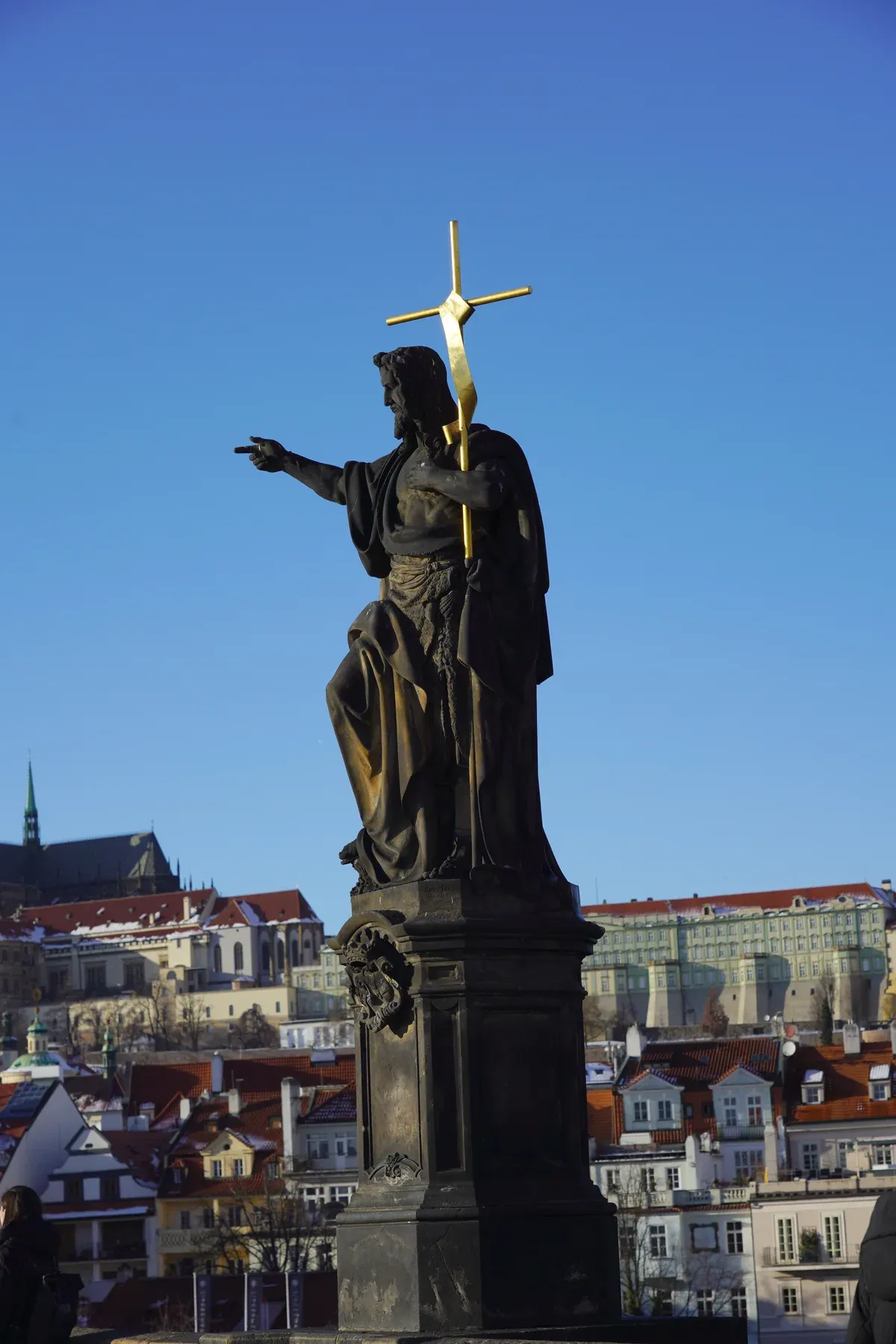
Charles Bridge, tied to the John of Nepomuk legend. Photo: Ray Swi-hymn, CC BY-SA 2.0, via Wikimedia Commons
Prague Castle and Hradčany
The castle hill holds the strongest stories of imprisonment and violent politics in Prague, plus the little golden lane that folklore wrongly gives to alchemists.
Golden Lane
Golden Lane sits in the northern part of the castle between the White Tower and Daliborka. The tiny houses were built into the arches of the northern fortification around 1500 for Rudolf II's castle guards, and the lane was first called the archers' lane before goldsmiths working there in the 17th century gave it its name. The alchemists of Rudolf II lived elsewhere in the castle area, not on the lane, whatever the souvenir shops suggest.
Fortune teller Matylda Průšová lived at No. 14 before the Second World War, and Kafka wrote in No. 22 for about a year after his sister rented it in 1916. The full guide with hours and tickets lives at Golden Lane Prague.
The Main Circuit covering Golden Lane, the Old Royal Palace, St George's Basilica and St Vitus costs 450 CZK for adults and 300 CZK discounted on the official price list from 2024, with tickets valid two days, so check the current list. Building hours are 9:00 to 16:00 from November to March and 9:00 to 17:00 from April to October. Prague.eu says the lane is free to walk after the paid hours, though the houses are closed, but one other guide says free access is unavailable, so confirm at the castle. The three hour castle alchemy walk covers the lane as an exterior stop for $32.07.
Daliborka
Daliborka tower, at the end of Golden Lane, was built in 1496 by Benedikt Ried as a prison and named after its first prisoner, Dalibor of Kozojedy, jailed in 1498 for sheltering rebelling serfs. It stayed a prison until 1781. You can still see four basement cells and an oubliette reached by a pulley.
The legend says Dalibor learned the violin in his cell and Prague people lowered food to him in baskets. Prague.eu notes the violin is an anachronism, since violins reached Bohemia about a century after his death, and suggests the tale grew from a saying that necessity taught Dalibor to sing, meaning torture drew a confession. Smetana made him the hero of the opera Dalibor, premiered in 1868. Check which castle ticket covers it.
Mihulka, the Powder Tower
Mihulka is the rounded 44 metre tower with a 20 metre diameter on the castle's north side, reached from Vikářská street. Built at the end of the 15th century, it held an alchemist's laboratory in Rudolf II's time, then served as a gunpowder store until 1754 and as a dungeon. It now houses a Castle Guard exhibition. Check which castle ticket covers it.
The castle myths and legends walk tells the alchemist stories from the outside for $20.61, since interiors are not included on that tour.
The Defenestrations
Prague had three defenestrations, in 1419, 1483 and 1618. The third, on 23 May 1618 at Hradčany Castle, saw Martinic, Slavata and secretary Fabricius thrown from a window. All three survived, and the Protestant claim that they landed on a dung heap appears to be a later invention. The event started the Bohemian Revolt that led into the Thirty Years War.
The reckoning came in 1621, when 27 Bohemian nobles were executed after the Battle of White Mountain. Their crosses on Old Town Square are covered in the Old Town section, and their heads, the story says, still walk the Charles Bridge where they were displayed.
Sources: Prague.eu on Golden Lane, hrad.cz on Mihulka, Wikipedia on the Defenestrations of Prague
New Town and Vyšehrad
South and east of the centre, two places carry legends of deals with the devil. One costs nothing to see, the other needs a guided tour ticket.
Faust House
Faust House, officially the Mladota Palace, stands on Karlovo náměstí and dates to the 14th century. The name comes from the building's alchemical reputation rather than from the historical Johann Georg Faust, who probably never visited Prague. Edward Kelley and the astrologer Jakub Krucinek are listed among its residents, and Ferdinand Antonín Mladota ran chemical experiments in the basement.
The legend says Faust was dragged through the ceiling to hell. The house is closed to the public and belongs to the First Faculty of Medicine of Charles University, so this is strictly an outside look. It costs nothing to stand on Karlovo náměstí and find the facade.
The Devil's Column
In Vyšehrad park stand three broken stone pieces that once formed a column in the Church of Saints Peter and Paul. They were moved to the park in 1888.
The legend says a priest bet the devil he could finish Mass before the devil fetched a column from Rome. The priest won, and the angry devil threw the column down, leaving it in three pieces. Prague.eu keeps a dedicated article on the tale. The column is free to visit, and the fortress itself, just over 3 km southeast of Prague Castle and dating from the 10th century. Libuše is said to have prophesied from Vyšehrad a great city whose glory touches the stars.
The Vyšehrad Casemates
Under the fortress lies a network of casemates leading to Gorlice Hall, described as the largest underground hall in historic Prague, which today holds original baroque statues from the Charles Bridge. The casemates can only be visited on a guided tour starting at the Brick Gate.
Admission is 330 CZK full price, 295 CZK online and 165 CZK reduced, daily 10:00 to 17:00. Tours run on a schedule, so confirm start times on site. Also on the hill, Dvořák and Mucha are buried in the Vyšehrad cemetery.
Sources: Wikipedia on Faust House), Wikipedia on the Devil's Column, Prague Visitor Pass on the casemates
Haunted Places at a Glance
This table gathers the haunted and legend sites covered on this half of the guide, from the bridge across to Vyšehrad. Costs are the admission figures given by the official sources cited in each section above, and free means you can see the place from public ground at no charge.
The Full List from the Bridge to Vyšehrad
Where a site sits inside a paid circuit, the circuit price is shown rather than a separate fee. Most of the evening ghost walks include no building entry, so budget for any interior you want.
| Place | Area | Legend | Cost |
|---|---|---|---|
| Charles Bridge | Malá Strana | The 27 executed nobles of 1621, whose heads were displayed here | Free |
| Bruncvík statue | Kampa | A magic sword walled into the bridge, waiting to leap out | Free |
| Nepomuk statue and cross | Charles Bridge | The priest thrown into the Vltava in 1393 | Free |
| Čertovka canal and Kabourek | Kampa | The House of Seven Devils and 9 water goblins on the stream | Free |
| Nový Svět | Hradčany | Tycho Brahe's street, no sourced ghost | Free |
| Černín Palace | Hradčany | The countess with bread slippers at a famine ball | Free, exterior only |
| Hunger Wall | Petřín | Famine workwall of 1360 to 1362 | Free |
| Golden Lane | Prague Castle | Fortune teller Průšová, Kafka's year at No. 22 | 450 CZK circuit, evening access reported free |
| Daliborka | Prague Castle | The imprisoned Dalibor and his impossible violin | Check which castle ticket covers it |
| Mihulka tower | Prague Castle | Alchemist laboratory, then gunpowder store and dungeon | Check which castle ticket covers it |
| Faust House | New Town | The devil took his man through the ceiling | Free, closed to the public |
| Devil's Column | Vyšehrad | The devil loses a bet and smashes a column from Rome | Free |
| Vyšehrad casemates | Vyšehrad | Underground halls under the fortress | 330 CZK, 295 CZK online |
Entry Tickets You Can Book Ahead
Seeing these places by day means buying the entry yourself. The official adult price comes from each site's own price list, and the booking link opens a dated e-ticket.
Tickets and Official Prices
The table sets each sight's official adult price beside a link to book the entry online. Reduced and family rates still apply at the gate where the site offers them, so check them before you pay.
| Sight | Official adult price | Book |
|---|---|---|
| Old Town Hall tower and Astronomical Clock | 350 CZK adult | Book the ticket |
| Jewish Museum circuit, with the Old Jewish Cemetery | 600 CZK adult | Book the ticket |
| Prague Castle main circuit, with Golden Lane | 450 CZK adult | Book the ticket |
| Devil's Channel (Čertovka) boat ride | Set on the operator's site | Book the ticket |
Haunted Prague: Questions and Answers
Is Prague a spooky city?
Yes, by reputation and by layout. Defenestrations, public executions of 27 nobles in 1621 and a plague that struck from 1713 to 1715 left a dense set of legends, and the old lanes are dark enough after sunset to carry them. The easiest way in is a walk such as Prague Ghosts and Legends Nighttime Guided Walking Tour at $21.
Does Prague have a dark history?
It does. Prague had three defenestrations, in 1419, 1483 and 1618, and the 1618 one started the Bohemian Revolt that led into the Thirty Years War. The 27 nobles executed on Old Town Square after 1620 are marked by 27 crosses in the pavement. The costumed Old Town night walk at $25 passes Old Town Square, the Old-New Synagogue and the Old Jewish Cemetery.
Is Charles Bridge haunted?
The legend says so. The 27 nobles beheaded in 1621 are said to haunt the bridge where their heads were displayed, and the priest John of Nepomuk was thrown from it into the Vltava in 1393. The ghost walk where legends come to life begins on the bridge side for $26.
Can you see haunted places in Prague for free?
Most of them. Charles Bridge, the Nepomuk cross, the Bruncvík statue, the Čertovka, the Hunger Wall, the Devil's Column at Vyšehrad and the outside of Faust House all cost nothing, and prague.eu says Golden Lane is free to walk after the interiors close. For orientation, the list of haunted places in Prague on this page groups them by area.
What is the dark story of Golden Lane?
The lane's 16th century houses were built for castle guards, and Daliborka tower at its end held prisoners until 1781, including Dalibor of Kozojedy, jailed in 1498. Fortune teller Matylda Průšová lived at No. 14 before the Second World War. Details, hours and the circuit ticket are at Golden Lane Prague.
Can you go inside Faust House in Prague?
No. Faust House on Karlovo náměstí is closed to the public and belongs to the First Faculty of Medicine of Charles University, so the legend of the ceiling hole is read from the street. For alchemy interiors, Speculum Alchemiae in the Old Town offers 30 minute guided tours of a real excavated laboratory.