 Ghost Tour Prague
The Golem of Prague: the Legend, the Rabbi and the Attic
The Golem of Prague is the city's most famous legend, a clay giant made by Rabbi Judah Loew to protect the Jewish quarter. This page tells the story as the sources give it, separates the legend from the history, and shows what actually survives in Josefov today. Rabbi Loew died on 17 September 1609, his tomb still stands in the Old Jewish Cemetery, and the attic of the Old New Synagogue is where the legend says the creature sleeps. The story is a literary invention of the early 19th century rather than a medieval tradition, which makes the visit no less interesting. If you want the tale told after dark on the streets where it is set, the ghost walks at the end of this page pass the exact spots. The bookable tours are compared on ghost tour in Prague.
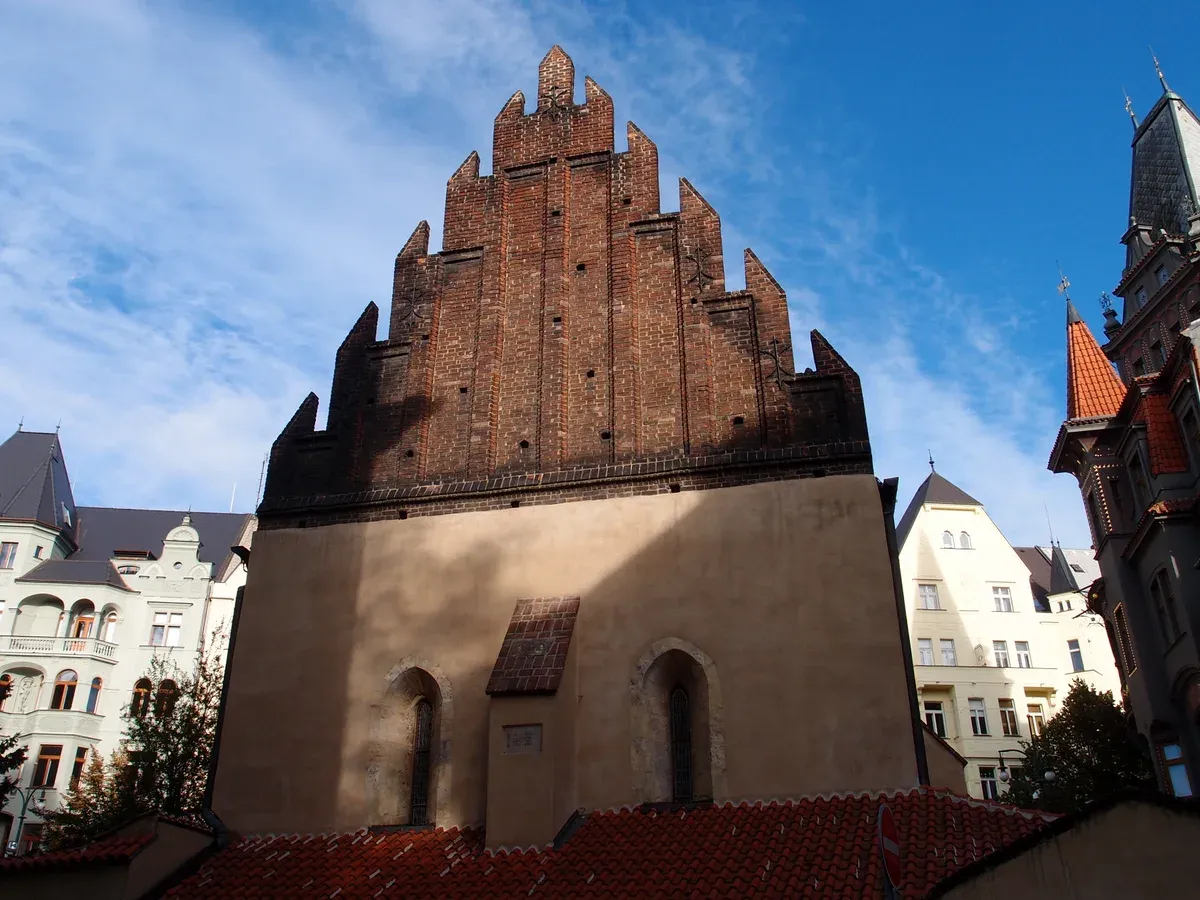
The Old New Synagogue, a short walk from the cemetery. Photo: Paljan84, CC BY-SA 3.0, via Wikimedia Commons
Quick answer The Golem in one minute
The Golem of Prague is a legendary clay giant made by Rabbi Judah Loew ben Bezalel, the Maharal, who died on 17 September 1609, to defend the Jewish community from antisemitic attacks. The legend says its body lies in the attic of the Old New Synagogue in Josefov, ready to be restored to life if needed. The attic was renovated in 1883 and explored again in 2014, and no trace of a golem was found. Historians describe the story as a German literary invention of the early 19th century, attached later to the real 16th century rabbi.
Key takeaways
- Read the story start to finish in the legend section, then see how the versions differ in Versions of the Story.
- Rabbi Loew is a real historical figure. See the documented dates and works in Rabbi Loew, the Man Behind the Legend, and his tomb in the Old Jewish Cemetery guide.
- Hear the tale on the streets: the Prague Ghosts and Legends Nighttime Guided Walking Tour ends at the Old Jewish Cemetery and costs $21.
- Planning a dark-side itinerary? The full list of haunted places in Prague goes beyond the Golem.
The Legend of the Golem of Prague
The legend places the story in the late 16th century Jewish quarter of Prague and at the door of its most famous rabbi. Here it is told as the sources give it.
The Making of the Clay Man
The legend says Rabbi Judah Loew ben Bezalel, the Maharal of Prague, shaped a man out of clay from the banks of the Vltava river. Prague's Jewish community lived under constant threat, and the legend is explicit about the purpose: the golem was made to defend it from antisemitic attacks. To bring the figure to life, the rabbi used Hebrew Kabbalistic incantations, a detail that Mysterium Tours keeps in its retelling of the story on its Esoteric Prague page.
The creature that walked out of that ritual was a servant without a soul, strong enough to carry out whatever the rabbi commanded and unable to want anything for itself. In the Prague telling it patrolled the ghetto at night, watching for anyone who came to plant false accusations or start violence against the Jews. The Maharal of the legend is the same man who really held the Prague rabbinate from 1573 and who really did stand before Emperor Rudolf II, so the story anchors itself to documented people and real streets.
That anchoring is deliberate in the way legends work. The Old New Synagogue, completed in 1270, gives the tale a building that still stands. The ghetto gives it streets you can still walk. The one thing the story does not have, as the history section explains, is any written record from the rabbi's own century.
The Shem and the Word on the Forehead
What keeps the golem alive is a shem. In the Prague legend this is a slip of paper bearing a name of God, placed in the creature's mouth or head, and the word emet, meaning truth, is written on its forehead. The shem is both the power source and the safety catch. As long as it stays in place, the clay man obeys. Remove it and the body collapses.
This is the detail the legend turns on twice. Every Friday evening Rabbi Loew took the shem out so the golem would rest on the Sabbath, because Jewish law forbids work on the day of rest and the creature is, in effect, pure work. The weekly removal also gives the story its tension. One slip and the servant becomes a disaster.
The forehead word matters in the ending too. In one version of the story the rabbi does not reach for the paper at all. He instead erases the first letter of emet, turning truth into met, meaning dead, and the letters on the clay forehead are what switch the creature off. So the answer to what was written on the golem's forehead is emet, truth, in the best-known versions, and the rabbi's final act is to shorten that word by one letter.
The Sabbath and the Rampage
The rampage has more than one telling. In the Czech retelling, the rabbi forgets to take the shem out before the Sabbath begins, and the golem, left switched on during the day of rest, smashes furniture and statues in the rabbi's own house. In this version the rabbi's seriously ill daughter recovers afterwards.
A second version gives the golem something closer to a motive. Here it falls in love, is rejected, and turns violent. The rabbi confronts it and immobilises it in front of the synagogue, in public, at the very doorway of the building the legend later claims still holds it.
Both endings land in the same place: the creature that was made to protect the community has to be put down by the man who made it. The Czech version adds a detail worth remembering when you stand in Josefov. The stopped golem crumbles to dust. Other tellings keep the body whole, which is the only reason an attic hiding place makes sense. The legend carries both options without resolving them, and the different endings are one more reason historians treat the whole story as literary rather than a single folk memory.
The Attic of the Old New Synagogue
The most famous part of the legend is where the golem ended up. The legend says the body, deactivated and still intact, lies in the attic genizah of the Old New Synagogue, ready to be restored to life if the community ever needs it again. A genizah is a storage place for worn-out religious texts, which makes the attic a fitting grave for a creature animated by a written name of God.
The attic itself has accumulated its own folklore. prague.eu records that Rabbi Jehuda Landau is said to have climbed to the attic in the second half of the 18th century and come back down pale and shaken. A 19th century rumour held that three men stole the golem's body and buried it near where the Žižkov television tower stands today.
The building keeps the legend physically alive. The attic door sits about twelve metres above ground, and the outside stairs were removed, so the space can only be reached with a ladder. Mysterium Tours adds that the lowest three metres of those stairs were taken away. The synagogue is Europe's oldest active synagogue, completed in 1270, and it closes an hour before the Sabbath begins, which keeps the weekly rhythm of the legend running in real time. The attic is not open to the public, so no visitor can check it. What visitors can see inside is the seat where Rabbi Loew traditionally sat.
Sources: Wikipedia: Golem, prague.eu: The Old New Synagogue, Mysterium Tours
Versions of the Story
The golem you meet in Prague today is a composite. The table below lines up the main versions the sources give, from the first German printings to the story as told on tonight's walks.
How the Telling Changed
The oldest datable layer is German. The earliest written accounts of the Prague golem appear in the 1830s and 1840s, by Berthold Auerbach in 1837, Gustav Philippson in 1841 and Abraham Tendlau in 1842, with Philippson and Franz Klutschak both publishing golem tales in 1841. Czech imagery followed: Mikoláš Aleš drew an early documented golem image in 1908 for the book Věnec pražských pověstí. Yudel Rosenberg's 1909 book added more detail, and academic circles recognise it as a literary hoax. Gustav Meyrink's 1915 novel and Paul Wegener's 1920 film carried the figure far beyond Prague, and the clay-giant look Czechs know today comes from the 1951 film Císařův pekař a pekařův císař, designed by sculptor Jaroslav Horejc.
The table compares these versions and where each appears. On today's tours, the Mysterium night walk tells the legend with Vltava clay and Kabbalistic incantations as it passes the Jewish Quarter, while the underground and dungeon tour shows a hidden alchemy laboratory where the Golem appears in the display, for $30.92 in a 70-85 minute circuit.
| Version | Where it appears | What changes |
|---|---|---|
| Early 19th century German accounts | Auerbach 1837, Philippson 1841, Tendlau 1842 | The first written Prague tellings in the sources, in German rather than Hebrew or Czech |
| Rosenberg's book | Nifl'os Maharal, 1909 | Claims eyewitness accounts from the Maharal's son-in-law via an old manuscript, which Gershom Scholem found to contain modern fiction |
| Meyrink's novel | Der Golem, 1915, set in the Prague ghetto | A literary reworking, illustrated by Hugo Steiner-Prag, that shaped how the ghetto and the golem were pictured |
| Wegener's film | Der Golem, wie er in die Welt kam, premiered in Berlin on 29 October 1920 | The third golem film by Wegener, shot at Tempelhof studios with sets by Hans Poelzig imagining the medieval ghetto |
| Czech screen golem | Císařův pekař a pekařův císař, 1951 | Fixed the clay-giant look still used in Prague today, designed by Jaroslav Horejc |
| The tour telling | Mysterium Tours, on the Old Town and Jewish Quarter night walk | Vltava river clay, Hebrew Kabbalistic incantations, the attic story told on the spot |
What Is Written on the Golem's Forehead
Across the versions the sources give, the word on the forehead is emet, the Hebrew word for truth. It is part of the animation mechanism in the Prague telling, alongside the shem, the slip of paper bearing a name of God placed in the mouth or head. Truth animates the clay, and the same word shortened to met, dead, is what the rabbi uses in one ending to switch the creature off for good, erasing the first letter after tricking it into taking off its boots so he can reach its forehead.
The detail gives the legend its clean moral symmetry. The golem is truth without judgment, power without restraint, and it is killed by an edit rather than a battle. It is also the reason the story cannot have a sequel. A creature destroyed by the removal of one letter of one word leaves no body to wake, whatever the attic legend claims.
Sources: Wikipedia: Golem of Prague, Wikipedia: The Golem (1920 film)), Czech Wikipedia: Golem
Rabbi Loew, the Man Behind the Legend
Rabbi Judah Loew ben Bezalel was a real and important scholar. The documented record about him is richer than the legend that grew onto it.
The Maharal of Prague
Rabbi Judah Loew ben Bezalel, known as the Maharal, was the late 16th century rabbi of Prague and the figure the golem story was later attached to. The safe dates start with his career: he had been Landesrabbiner of Moravia at Mikulov from 1553 and took the Prague rabbinical post in 1573. His family life is documented too. He was married to Perel and had six daughters and a son named Bezalel, and his pupils included the scholar Yom-Tov Lipmann Heller.
One meeting gives the legend its imperial hook. On 23 February 1592 Rabbi Loew had an audience with Emperor Rudolf II, and it appears to have concerned Kabbalah, the very mystical tradition the golem story leans on. A real documented meeting between the rabbi and the alchemy-mad emperor is exactly the kind of seed a legend needs.
His birth year is genuinely disputed across sources, and his family may have come from Worms while he was probably born in Poznań. The certain end point is his death on 17 September 1609 in Prague.
What He Actually Wrote
The Maharal's surviving work is Jewish philosophy and commentary. He published his supercommentary on Rashi, Gur Aryeh, in 1578. Gevurot ha-Shem followed in 1582 and Derech Chaim, his commentary on Pirkei Avot, in 1589. Be'er ha-Golah was printed in Prague in 1598 and Netzach Yisrael in 1599. His main works on Jewish thought are Gevurot ha-Shem, Tiferet Yisrael and Netzach Yisrael.
Historians generally describe the Golem of Prague story as a German literary invention of the early 19th century, attached later to the real 16th century rabbi.
The gap matters for visitors. Everything you see in Josefov connected to Loew is real: his writing, his grave, his seat in the synagogue. Everything connected to the golem is later literature.
His Grave in the Old Jewish Cemetery
Rabbi Loew is buried in the Old Jewish Cemetery in Josefov, and his grave and tombstone survive intact. The cemetery dates from the first half of the 15th century, its oldest gravestone is dated 1439, and the last burials date to the 1780s. Because Jewish custom forbids disturbing graves, the community stacked burials in layers, and Loew's tomb sits among notable graves including Mordecai Maisel and the historian and astronomer David Gans, who died in 1613.
His grave is one of the most visited in the cemetery. Visitors leave pebbles and folded paper wishes called kvitlach on the stone.
For tickets, hours and the other graves worth finding, see the dedicated Old Jewish Cemetery guide. One practical note: the cemetery is part of the Jewish Museum circuit, adult admission is 600 CZK, and a full visit to the circuit takes about 2 to 3 hours.
The Rabbi Loew Statue at New City Hall
Prague honoured the Maharal in stone. Ladislav Šaloun's statue of Rabbi Loew sits in a recess on the main facade of the New Town Hall on Mariánské náměstí, a building raised in 1909 to 1911 by architect Osvald Polívka, who invited Šaloun to contribute. Šaloun chose Rabbi Loew to symbolise the whole Jewish Quarter instead of the usual allegorical figures. The statue is 6 metres high including its pedestal, and the stone figure alone measures 360 cm.
The composition is strange enough to stop you. It shows the rabbi with a nude young girl holding out a rose whose scent brings about his death, and a small dog sits on the other side. A replica dated 1914 stands in the Maisel Synagogue, which is on the Jewish Museum circuit.
The Czech state has marked the man repeatedly: commemorative stamps in 1997 and 2009 and a coin in 2009. So if you searched for a golem of Prague statue, the honest answer is that there is no golem statue, but there is a large public statue of the man said to have made it, and it is free to see on Mariánské náměstí between the Old Town Square and the river.
Sources: Wikipedia: Judah Loew ben Bezalel, Visit Czechia: Rabbi Loew statue, Wikipedia: Old Jewish Cemetery
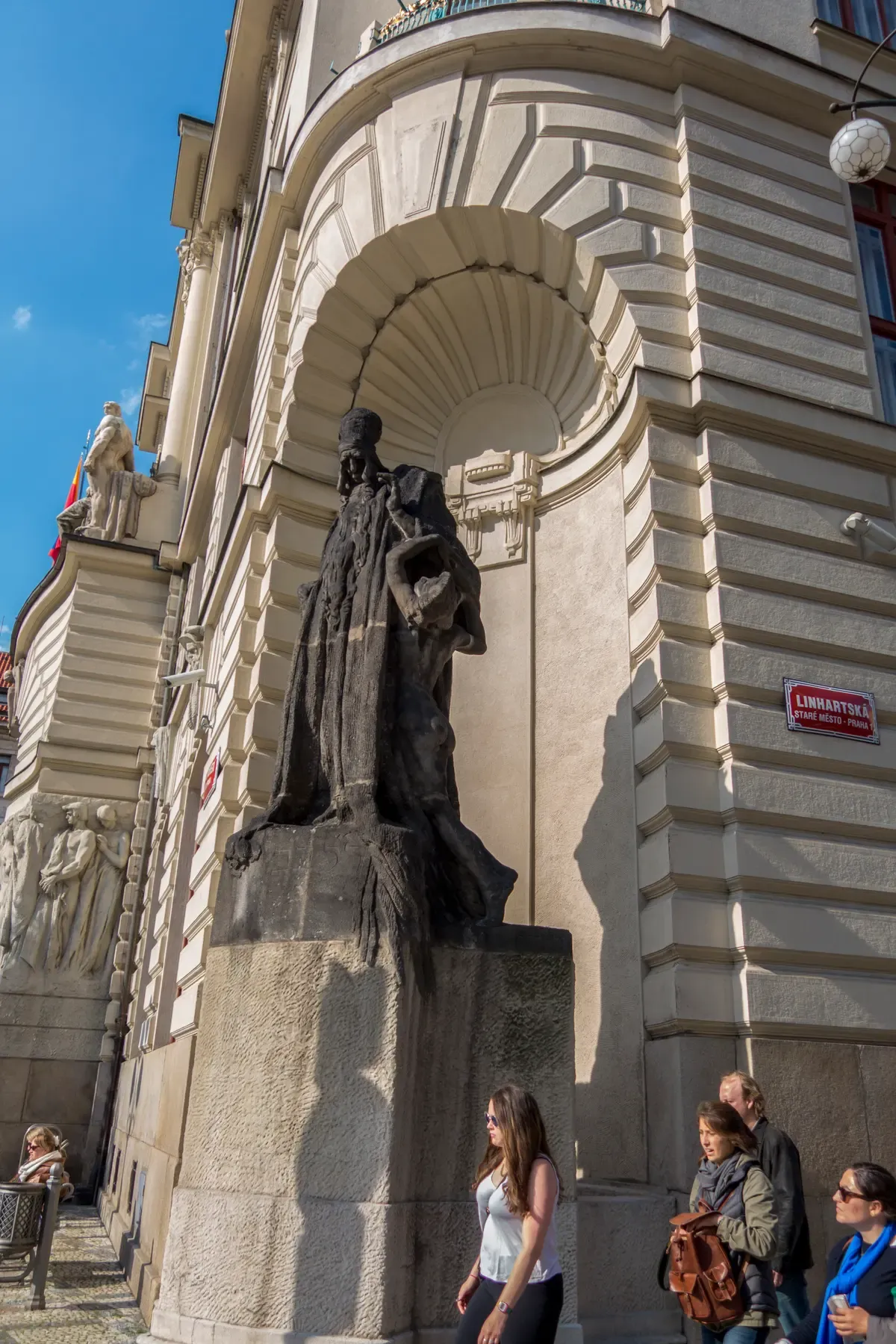
The Rabbi Loew statue at New City Hall. Photo: Jerzy Strzelecki, CC BY-SA 3.0, via Wikimedia Commons
Is the Golem of Prague Real?
The short answer from historians is no. The Golem of Prague is a literary creation of the early 19th century, attached decades later to a real 16th century rabbi.
What Historians Say
The tale of Rabbi Loew shaping a clay defender is usually described by historians as a German-language literary invention of the early 19th century, not a medieval tradition. The earliest written accounts of the Prague golem appear in German in the 1830s and 1840s. Berthold Auerbach wrote a version in 1837. Gustav Philippson and Franz Klutschak published golem tales in 1841. Abraham Tendlau followed in 1842.
The rabbi himself was real. Rabbi Judah Loew ben Bezalel took his Prague post in 1573, met Emperor Rudolf II on 23 February 1592 for what appears to have been a discussion of Kabbalah, and died in Prague on 17 September 1609. He wrote books on Jewish thought, including Gevurot ha-Shem from 1582 and Netzach Yisrael from 1599. The Golem of Prague story owes more to the 19th century than to the 16th.
A later boost came from Yudel Rosenberg, whose 1909 book Nifl'os Maharal claimed to rest on an old manuscript and eyewitness accounts from the Maharal's son-in-law. Gershom Scholem examined it and found modern fiction rather than ancient legend. Academic circles generally recognise the book as a literary hoax. If you see the story told with confident detail, that confidence usually traces back to 1909.
- Earliest written Prague golem tales: German, 1830s to 1840s, by Auerbach, Philippson, Klutschak and Tendlau
- Historians' verdict: a German literary invention of the early 19th century
- Rosenberg's 1909 manuscript claim: a recognised literary hoax
The Attic Searches: 1883 and 2014
The legend says the golem's body lies in the attic genizah of the Old New Synagogue, ready to be restored to life if the community ever needs it. Two searches have tested that claim directly. The attic was renovated in 1883 and workers found no physical trace of a golem. The attic was explored again in August 2014, and again no trace of a golem was found.
There were earlier visitors too. The journalist Egon Erwin Kisch climbed into the attic in 1920 and found no golem remains, only bricks, a dead bird and a bat. Researcher Ivan Mackerle scanned the synagogue with geological radar in the 1980s and found nothing unusual. A 19th century rumour tried to explain the empty attic by claiming three men stole the body and buried it near where the Žižkov television tower stands today. No evidence supports that story either.
- 1883 attic renovation: no physical trace of a golem
- August 2014 exploration: no trace found
- Egon Erwin Kisch in 1920: bricks, a dead bird and a bat
Can You See the Attic?
No. The attic of the Old New Synagogue is not open to the public. The outside stairs that once led up to it were partly removed. Mysterium Tours, which tells the golem story on its walks, says the lowest three metres of the outside stairs were taken away. The official Prague tourism site puts the attic door about twelve metres above ground and confirms the stairs are gone, so the door can only be reached with a ladder today.
A story from the second half of the 18th century says Rabbi Jehuda Landau went up to the attic and came back down pale and shaken. That is a legend, like the rest of it, but the practical result is real: there is no way for a visitor to look inside. You can read the door and the bricked-in window from the street, and a guide can tell you the rest.
- Attic open to visitors: no
- Attic door height: about twelve metres above ground
- Lowest three metres of the outside stairs: removed
Where Is the Golem of Prague Now?
The legend places the golem in the attic genizah of the Old New Synagogue in Josefov, folded in the dust above the prayer hall. That is where the story says it waits. The searches in 1883, 1920, the 1980s and August 2014 found nothing, so the honest answer is that the golem is not there. It exists now in stories, films, books and a few places in the city that borrow its name.
If you want to stand at the spot the legend points to, the Old New Synagogue in Josefov is a working synagogue and its exterior is visible from the street. To see inside, the synagogue is part of the Jewish Town circuit run by the Jewish Museum in Prague. Admission to that circuit is 600 CZK for adults, with children aged 7 to 15 at 200 CZK and students under 26 at 400 CZK, and a full visit takes about 2 to 3 hours. For the golem story told in the streets at night, see the tours listed further down this page.
Sources: Wikipedia, Prague.eu, Jewish Museum in Prague
Where to Find the Golem in Prague Today
There is no golem statue in Prague and no golem museum. What you can visit are the three real places the legend grew around, plus a restaurant and a few tour stops that keep the story alive.
The Old New Synagogue
The Old New Synagogue in Josefov was completed in 1270 and is Europe's oldest active synagogue. It is the oldest surviving medieval synagogue of twin-nave design, with six-bay vaulting whose bays carry five ribs instead of the usual four or six. Twelve narrow Gothic windows ring the hall, said to stand for the twelve tribes of Israel. Inside, visitors can see the seat where Rabbi Loew traditionally sat.
The golem connection is above your head. The tall attic door and the bricked-in window facing the street mark the space where the legend says the clay body rests. Since the stairs were cut away, the door sits about twelve metres above the pavement, reachable only with a ladder. A separate golem story hangs on the building too: legend credits angels turned into doves with saving the synagogue from the 1558 ghetto fire. Since 1 January 2024 the Old New Synagogue can no longer be bought as a separate ticket, so you need the Jewish Town circuit. The museum recommends buying in advance and avoiding the busiest hours from 11:00 to 15:00.
- Completed in 1270, Europe's oldest active synagogue
- Attic door about twelve metres above ground, stairs removed
- Inside the 600 CZK Jewish Town circuit, closed Saturdays and Jewish holidays
The Grave of Rabbi Loew
Rabbi Loew is buried in the Old Jewish Cemetery in Josefov, and his grave and tombstone survive intact. Visitors leave pebbles and folded paper wishes called kvitlach on the stone. His grave shares the cemetery with Mordecai Maisel, the financier and mayor who died in 1601, and David Gans, the historian and astronomer who died in 1613.
The cemetery itself dates from the first half of the 15th century, with its oldest gravestone dated 1439 and burials continuing until the 1780s. Tickets, opening hours and the full list of notable graves belong to the separate guide to the Old Jewish Cemetery in Prague, which covers admission in detail. The short version here: the cemetery is inside the Jewish Museum ticket, and a visit usually takes about 30 minutes.
The Rabbi Loew Statue at the New City Hall
A statue of Rabbi Loew stands at the New City Hall on Mariánské náměstí, set into a recess on the main facade. The sculptor Ladislav Šaloun made it, and he chose Rabbi Loew to symbolise the whole Jewish Quarter instead of the usual allegorical figures. The New Town Hall was built from 1909 to 1911 by architect Osvald Polívka, who invited Šaloun to work on it.
The figure is large. Including its pedestal the statue is 6 metres high, and the stone rabbi alone measures 360 cm. It is an odd, haunting composition: a nude young girl holds out a rose whose scent brings about the rabbi's death, and a small dog sits on the other side. A smaller replica of Šaloun's statue, dated 1914, stands in the Maisel Synagogue, which is one of the five sites on the Jewish Museum circuit.
Other Golem Traces in the City
The golem has spread beyond Josefov. Restaurant U Golema at Maiselova 8 in Josefov is decorated with golem memorabilia, so you can eat a meal under clay-giant imagery a few streets from the synagogue. Sculptor David Černý made a steel golem sculpture, though it was installed in Poznań in 2011, not in Prague.
In pictures, the Czech painter Mikoláš Aleš drew an early documented golem image in 1908 for the book Věnec pražských pověstí, and the clay-giant look Czechs know today comes from the 1951 film Císařův pekař a pekařův císař, with the figure designed by sculptor Jaroslav Horejc. If you want the whole haunted quarter beyond the golem, the guide to haunted places in Prague lists the spots you can see free.
- Restaurant U Golema, Maiselova 8: golem memorabilia
- Mikoláš Aleš drew the golem in 1908
- The modern clay-giant look dates from the 1951 film
Golem Sites at a Glance
This table gathers the places tied to the Golem of Prague and what each costs to see. Synagogue and cemetery prices are the Jewish Museum's own admission figures. The statue and the restaurant cost nothing to enter.
| Place | What you see | Cost |
|---|---|---|
| Old New Synagogue, Josefov | The attic door about twelve metres up, Rabbi Loew's seat inside | 600 CZK adult, 400 CZK student under 26, 200 CZK child 7-15 (Jewish Town circuit) |
| Audio guide for the circuit | About two hours of commentary | 250 CZK adult, 200 CZK child under 15 and student under 26 |
| Old Jewish Cemetery | Rabbi Loew's grave with pebbles and kvitlach | Covered by the circuit ticket, about 30 minutes |
| Rabbi Loew statue, New City Hall | Šaloun's 6 metre statue on Mariánské náměstí | Free, outdoors |
| Restaurant U Golema, Maiselova 8 | Golem memorabilia and a meal | Menu prices, not stated |
Sources: Wikipedia, Jewish Museum in Prague, Visit Czechia
Ghost Tours That Tell the Golem Story
Four bookable walks on record pass the places where the Golem of Prague legend lives. Two walk past the Old New Synagogue, one shows a hidden alchemy laboratory where the Golem appears, and one tells Golem stories around Prague Castle.
Which Tours Cover the Golem
The routes below come from the tour listings. Prague Ghosts and Legends Nighttime Guided Walking Tour and Prague Ghost Tour with a Costumed Storyteller both walk past the Old New Synagogue and the Old Jewish Cemetery, which makes them the closest fit to this legend. The first finishes at the cemetery and the costumed tour ends at the Astronomical Clock. Prague Ghosts, Legends, Medieval Underground and Dungeon Tour is the only one where the Golem is a stop on the route, inside a hidden alchemy laboratory. Alchemy and Mysteries of Prague Castle Walking Tour tells Golem stories along with Rudolf II and alchemy, though around the castle and Golden Lane, not Josefov.
Be honest with yourself about what a booking buys. None of these tours enters the Old New Synagogue. Entry to buildings is not included on the walks, so the Golem stops are exteriors and street stories. If you want the inside of the synagogue, buy the Jewish Museum circuit separately, at 600 CZK for adults, and see it by day.
| Tour | Price | Length | Golem stop |
|---|---|---|---|
| Prague Ghosts and Legends Nighttime Guided Walking Tour | $21 | 100 minutes to 2 hours | Old-New Synagogue, ends at the Old Jewish Cemetery |
| Prague Ghost Tour with a Costumed Storyteller | $25 | 1.5 hours | Old-New Synagogue and Old Jewish Cemetery, exterior stops |
| Prague Ghosts, Legends, Medieval Underground and Dungeon Tour | $30.92 | 70-85 minutes | Hidden alchemy laboratory with the Golem, entry fees included |
| Alchemy and Mysteries of Prague Castle Walking Tour | $32.07 | 3 hours | Golem stories around Prague Castle and the Golden Lane, exteriors only |
Choosing Between Them
If your priority is the legend in its home streets, the $21 Mysterium night walk and the $25 costumed tour both cover the Jewish Quarter after dark. The Mysterium walk runs in English, German or Italian with a costumed storyteller, and meets on Old Town Square. The costumed tour is English only, runs in early 1900s dress and contains no jump scares.
The $30.92 underground tour is the only one where the Golem is part of what you physically see, in a hidden alchemy laboratory, with all entry fees in the ticket and groups of up to 26. The $32.07 castle walk spends 3 hours on Rudolf II, alchemy and the Golem high above the river instead. Start times on the listings show when you check availability for your date. For the wider choice of night walks beyond the Golem, the homepage compares every ghost tour in Prague by price, length and route.
Prices and routes from the tour listings on the booking platforms
Book the Entry Ticket Ahead
Seeing these places by day means buying the entry yourself. The official adult price comes from each site's own price list, and the booking link opens a dated e-ticket.
Ticket
The table sets each sight's official adult price beside a link to book the entry online. Reduced and family rates still apply at the gate where the site offers them, so check them before you pay.
| Sight | Official adult price | Book |
|---|---|---|
| Jewish Museum circuit, with the Old Jewish Cemetery | 600 CZK adult | Book the ticket |
Golem of Prague: Questions and Answers
Where is the Golem of Prague now?
The legend places the golem in the attic genizah of the Old New Synagogue in Josefov, ready to be restored to life if needed. Searches of the attic found no trace, so it lives in stories rather than in clay. The tours above take you to the spots where the tale is told.
What was written on the Golem's forehead?
In one ending of the story, the word emet, meaning truth, appears on the golem's forehead. The rabbi tricks the creature into taking off its boots so he can reach its forehead and erase the first letter, leaving met, meaning dead, and the golem stops. In the Czech retelling it crumbles to dust.
Is the Golem of Prague real?
Historians generally regard the story as a German literary invention of the early 19th century, first written down in the 1830s and 1840s and later attached to the real 16th century Rabbi Judah Loew. The 1883 attic renovation and the 2014 exploration found nothing.
Is there a movie about the Golem of Prague?
Yes, several. Paul Wegener directed and starred in Der Golem, wie er in die Welt kam, which premiered in Berlin on 29 October 1920 with sets by Hans Poelzig imagining the medieval ghetto. Julien Duvivier filmed Le Golem in 1936, and the Czech clay-giant look comes from the 1951 comedy Císařův pekař a pekařův císař. The golem has also appeared in The X-Files, Grimm and The Simpsons.
Who made the Golem?
In the legend, Rabbi Judah Loew ben Bezalel, the Maharal of Prague, made the golem from clay to defend the Jewish community from antisemitic attacks. Mysterium Tours tells the version with Vltava river clay and Hebrew Kabbalistic incantations. The historical rabbi was real and died in Prague on 17 September 1609.
Can you go into the Old New Synagogue attic?
No. The attic is not open to the public. The attic door sits about twelve metres above ground and the outside stairs were removed, so it can only be reached with a ladder. You can see the door from the street and the synagogue interior is part of the Jewish Museum's 600 CZK circuit.