 Ghost Tour Prague
Old Jewish Cemetery Prague: A Visitor Guide to the Graves and the Layers
The Old Jewish Cemetery in Prague is a crowded burial ground with some 12,000 tombstones standing in a plot where people were buried in stacked layers. This guide covers its history from the first half of the 15th century to the last burial, the notable graves including Rabbi Loew, Mordecai Maisel and David Gans, and exactly how to visit it today. Admission runs 600 CZK for adults through the Jewish Museum ticket, the entrance sits at Široká 3 inside the Pinkas Synagogue, and the sites close on Saturdays and Jewish holidays. You will also find which evening ghost walks pass the cemetery wall after dark, and what they do and do not include. The bookable tours are compared on ghost tours in Prague.
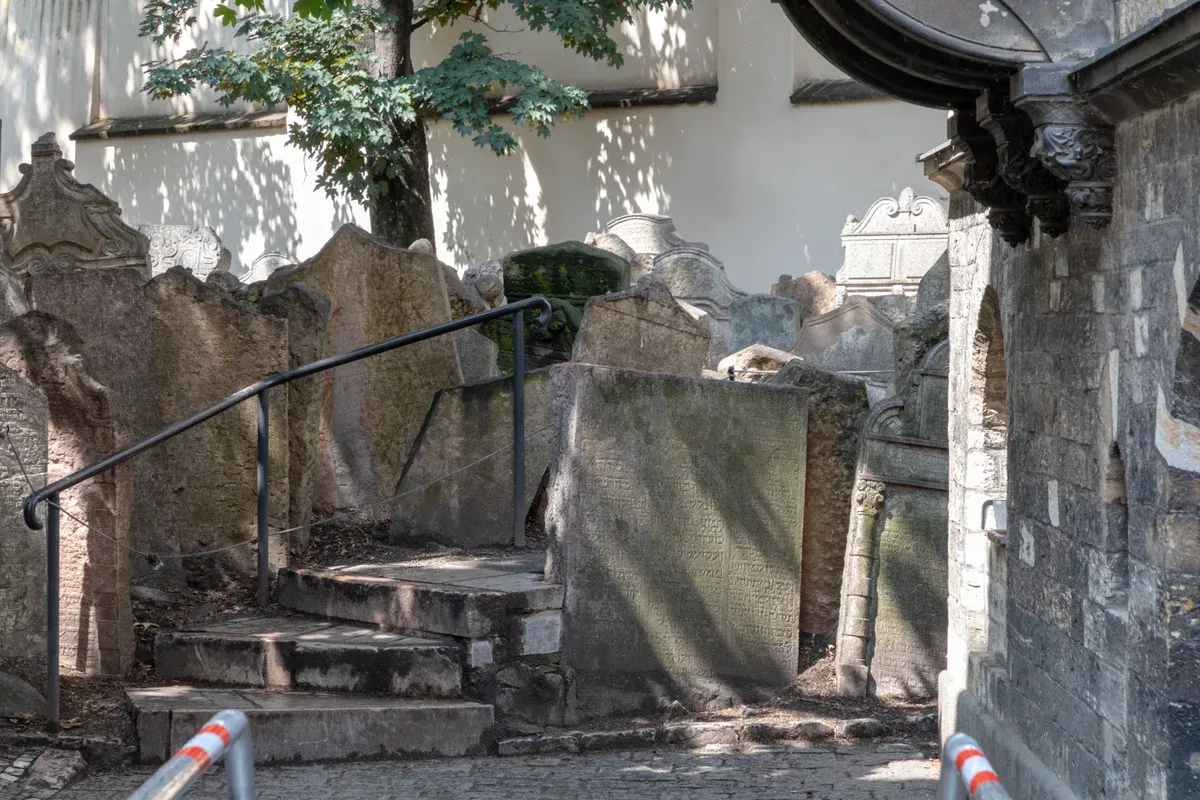
The Old Jewish Cemetery, the finish of the walk. Photo: Dietmar Rabich, CC BY-SA 4.0, via Wikimedia Commons
Quick answer Visiting in short
Yes, you can visit the Old Jewish Cemetery in Prague. Admission is 600 CZK for adults with the Jewish Museum ticket, which also covers the Maisel, Pinkas, Old New and Spanish synagogues. The entrance is at Široká 3 in Josefov, inside the Pinkas Synagogue building. The museum recommends setting aside about 30 minutes for the cemetery alone and 2 to 3 hours for the full circuit.
Key takeaways
- Plan your visit with the prices, hours and entrance details in the history and visiting section.
- Find Rabbi Loew, Mordecai Maisel and David Gans in the guide to the notable graves.
- The legend of the golem belongs to the Golem of Prague page, with a short summary of the story here.
- Prefer the cemetery after dark? See how the ghosts and legends night walk finishes at its wall.
History of the Old Jewish Cemetery
A burial ground squeezed into the Prague ghetto that served the community from the first half of the 15th century to the 1780s.
How Old Is the Cemetery
The Old Jewish Cemetery dates from the first half of the 15th century, and its oldest preserved gravestone is dated 1439. The cemetery sits in Josefov, the former Jewish quarter of Prague.
The quarter around it is older still. The first pogrom recorded in the quarter's history was in 1096. Most of the old ghetto was demolished between 1893 and 1913 in a Paris-style modernisation, and the cemetery is one of the few things that survived that clearance, alongside six synagogues and the Jewish Town Hall. The quarter was renamed Josefstadt in 1850 after Emperor Joseph II, who issued the 1782 Edict of Tolerance.
Today the cemetery is administered by the Jewish Museum in Prague, which was founded in 1906 by Salomon Hugo Lieben and August Stein. That administration is why the only way in is with the museum's ticket, covered in the visiting section below.
Why the Graves Stand in Layers
The cemetery looks the way it does for one reason: space. Jewish custom forbids disturbing existing graves. The community could not clear the old burials, so it stacked new ones on top.
Graves were placed in layers, with soil brought in between them. Wikipedia and prague.eu describe up to twelve layers of soil, while the Jewish Museum's own cemetery page speaks of up to ten, so treat the figure as roughly ten to twelve depending on the source.
Old stones were not discarded when a new layer went in. They were lifted and set back on top of the fresh soil, which is why the tombstones crowd so tightly together today. Prague.eu sources describe some 12,000 visible tombstones, and one source estimates about 100,000 interments in total, an estimate worth taking as exactly that.
Two gravestone types dominate the plot. One is the upright rectangular slab, the older and simpler form. The other is the baroque tumba, shaped like a small house, which appears on later graves of wealthier families. The stones carry symbols instead of photographs: a lion stands for the name Judah, and other marks tell the trade or family of the person below.
The Last Burial and What Happened After
The last gravestone in the cemetery is dated 1787. Emperor Joseph II had banned burials within the city walls three years earlier for hygiene reasons, and the ban closed this ground. The Jewish Museum cites 1787 as the final burial, so that is the figure to trust over looser accounts that say the 1780s generally.
After the ban the cemetery stayed as the dense field of stones you see now. The Jewish Museum estimates a cemetery visit usually takes about 30 minutes.
A practical note that catches visitors out: the museum's sites close on Saturdays and on Jewish holidays, because this is an active sacred site, not a city park. Ticket sales also end 30 minutes before closing. The ghost walks that pass the cemetery in the evening see it from the outside only, since the ground itself shuts with the museum.
Visiting Today: Ticket, Prices and Hours
There is no separate cemetery ticket. Admission runs through the Jewish Museum in Prague, whose circuit covers the Maisel, Pinkas, Old New and Spanish synagogues plus the Old Jewish Cemetery. Individual adult admission is 600 CZK, students under 26 pay 400 CZK and children aged 7 to 15 pay 200 CZK. Children up to 6 enter free and disability card holders pay 100 CZK. Tickets are valid for 3 opening days.
An audio guide costs 250 CZK for adults and 200 CZK for children under 15 and students under 26, and it lasts about two hours. Tickets are sold online and at the ticket offices in the Spanish, Klausen, Pinkas and Maisel synagogues. The museum recommends buying in advance and avoiding the busiest hours from 11:00 to 15:00.
Opening hours change with the season. In 2026 the sites open 9:00 to 16:30 from 2 January to 31 March, 9:00 to 18:00 in April, 9:00 to 19:00 from 1 May to 31 August, 9:00 to 18:00 from 1 September to 17 October, and 9:00 to 16:30 from 18 October to 31 December. On 24 December they close at 14:00. They shut entirely on Saturdays and Jewish holidays, which in 2026 include Pesach on 2 to 3 and 8 to 9 April, Shavuot on 22 May, Rosh Hashanah on 13 September, Yom Kippur on 21 September, Sukkot on 27 September and Simchat Torah on 4 October.
The Old New Synagogue is run by the Jewish Community rather than the museum and usually closes an hour before the Sabbath begins. Since 1 January 2024 it can no longer be bought as a separate ticket and is part of the Jewish Town circuit.
Photography for personal use is allowed without tripod, extra lighting or flash. Professional or commercial photography needs prior agreement and a fee, and filming applications must be sent at least a week ahead. Note that no ticket includes entry to any building on an evening ghost walk, including the Mysterium night walk that ends at the cemetery wall, which lists entry to buildings as not included.
Who Is Buried in the Old Jewish Cemetery
Roughly 100,000 people are thought to lie here across the stacked layers, and a handful of graves draw nearly every visitor.
The Notable Graves and What to Look for
The table below gathers them with the dates the sources give and the marker you should look for. The most valuable background comes from the Jewish Museum's own cemetery page, which lists the same burials. Allow yourself the museum's estimated 30 minutes for the whole cemetery.
If you only have time for two, make them Rabbi Loew and Mordecai Maisel, the scholar and the financier who between them define the story of the old ghetto. Photography is allowed for personal use without flash, so you can photograph each stone as you find it.
| Name | Died or dated or dated or dated | Who they were | What to look for |
|---|---|---|---|
| Rabbi Judah Loew ben Bezalel (the Maharal) | 17 September 1609 | The late 16th century rabbi of Prague, tied to the Golem legend | Visitors leave pebbles and folded paper notes called kvitlach on the stone |
| Mordecai Maisel | 1601 | Mayor of the Jewish Town and its great financier | Listed among the notable graves on the Jewish Museum's cemetery page |
| David Gans | 1613 | Historian and astronomer | Listed among the notable graves on the Jewish Museum's cemetery page |
| Oldest dated gravestone | 1439 | The oldest dated gravestone in the cemetery, from 1439 | The earliest stone in the cemetery |
| Mordecai Katz | 1592 | Printer | Listed on the Jewish Museum's cemetery page |
| David Oppenheim | 1736 | Chief Rabbi whose library is now at the Bodleian Library in Oxford | Listed on the Jewish Museum's cemetery page |
Rabbi Loew's Grave: Pebbles and Paper Notes
Rabbi Judah Loew ben Bezalel, known as the Maharal, took the rabbinical post in Prague in 1573 after serving as Landesrabbiner of Moravia at Mikulov from 1553. On 23 February 1592 he had an audience with Emperor Rudolf II, which appears to have concerned Kabbalah. He died on 17 September 1609 in Prague and is buried in this cemetery, where his grave and tombstone survive intact. His birth year is disputed across sources, so only the death date is reliable.
Two things mark the grave out. First, the pebbles. Visitors leave small stones on Loew's grave. Second, the notes. Visitors leave folded paper wishes called kvitlach tucked among the stones.
The Golem legend is the reason most visitors come looking for him. In the story, Rabbi Loew built a man of clay to defend the Jewish community from antisemitic attacks, and the legend says the creature's body still lies in the attic of the Old New Synagogue. The legend is usually described by historians as a literary creation of the early 19th century attached to the real 16th century rabbi, and the attic was explored with no trace of a golem found. The full story, its film history and the hunts through the synagogue attic belong on the Golem of Prague page.
Loew's memory extends well beyond the cemetery. The Czech government issued commemorative stamps for him in 1997 and 2009 and a coin in 2009. Ladislav Šaloun's statue of the rabbi, 6 metres high including its pedestal, sits on the New Town Hall on Mariánské náměstí, and a replica dated 1914 stands in the Maisel Synagogue. Visitors to the Old New Synagogue can see the seat where Rabbi Loew traditionally sat.
Sources: Jewish Museum in Prague, admission, Jewish Museum in Prague, opening hours, Jewish Museum in Prague, Old Jewish Cemetery, Prague.eu, Old Jewish Cemetery, Wikipedia, Old Jewish Cemetery, Wikipedia, Judah Loew ben Bezalel
How to Visit: Tickets, Hours and the Entrance
You cannot buy a ticket for the Old Jewish Cemetery on its own. It sits inside the Jewish Museum circuit, and that ticket decides when and how you see it.
The Ticket That Includes the Cemetery
The cemetery is administered by the Jewish Museum in Prague, and admission goes through the museum circuit ticket. Individual adult admission is 600 CZK, students under 26 pay 400 CZK and children aged 7 to 15 pay 200 CZK. Children up to 6 enter free and disability card holders pay 100 CZK. The ticket covers the Maisel, Pinkas, Old New and Spanish synagogues plus the Old Jewish Cemetery, and the museum describes a full visit as about 2 to 3 hours. Tickets are valid for 3 opening days, so you can split the sites across several visits. The audio guide costs 250 CZK for adults and 200 CZK for children under 15 and students under 26, and it runs about two hours. Tickets are sold online and at ticket offices in the Spanish, Klausen, Pinkas and Maisel synagogues. The museum recommends buying in advance and avoiding the busiest hours from 11:00 to 15:00.
One honest warning about the synagogue on the circuit. Since 1 January 2024 the Old New Synagogue can no longer be bought as a separate ticket, so do not look for a standalone price. The old separate prices are gone and the synagogue is part of the Jewish Town circuit. Prices in the table come from the Jewish Museum's own admission pages.
| Ticket | Adult | Student | Child | What it covers |
|---|---|---|---|---|
| Jewish Museum circuit | 600 CZK | 400 CZK (under 26) | 200 CZK (7 to 15), free up to 6 | Maisel, Pinkas, Old New and Spanish synagogues plus the Old Jewish Cemetery |
| Audio guide | 250 CZK | 200 CZK (under 26) | 200 CZK (under 15) | About two hours of commentary on the circuit |
| Disability card holders | 100 CZK | 100 CZK | Not stated | Same circuit access |
Opening Hours by Season
The Jewish Museum sites follow a seasonal calendar, and the cemetery follows it with them. In 2026 they are open 9:00 to 16:30 from 2 January to 31 March, then 9:00 to 18:00 in April. The summer window is the longest, 9:00 to 19:00 from 1 May to 31 August.
From 1 September to 17 October hours run 9:00 to 18:00, and from 18 October to 31 December they drop back to 9:00 to 16:30. Ticket sales end 30 minutes before closing, so arrive before the last entry. Two special days sit outside the pattern.
On 24 December 2026 the sites close at 14:00 and on 1 January 2026 they opened 11:00 to 16:30.
| Season | Hours | Note |
|---|---|---|
| 2 January to 31 March | 9:00 to 16:30 | Ticket sales end 30 minutes before closing |
| April | 9:00 to 18:00 | Ticket sales end 30 minutes before closing |
| 1 May to 31 August | 9:00 to 19:00 | Longest opening window |
| 1 September to 17 October | 9:00 to 18:00 | Ticket sales end 30 minutes before closing |
| 18 October to 31 December | 9:00 to 16:30 | 24 December closes at 14:00 |
Closed Saturdays and Jewish Holidays
The Jewish Museum sites are closed on Saturdays and on Jewish holidays. That includes the cemetery, so plan the visit on a weekday or a Sunday. The museum lists the 2026 holiday closures as Pesach on 2 to 3 and 8 to 9 April, Shavuot on 22 May, Rosh Hashanah on 13 September, Yom Kippur on 21 September, Sukkot on 27 September and Simchat Torah on 4 October.
The Old New Synagogue is run separately by the Jewish Community and usually closes an hour before the Sabbath begins. Check the museum's page before you travel if your dates fall near a holiday, because a Friday afternoon visit can run into Sabbath closures at some sites.
The Entrance and How Long to Allow
The cemetery entrance is at Široká 3, Prague 1, inside the Pinkas Synagogue building. That is the practical detail most visitors miss. You enter through the Pinkas Synagogue first, where the walls carry about 80,000 names of Jewish victims from Bohemia and Moravia.
The Jewish Museum says a cemetery visit usually takes about 30 minutes. Walk the whole circuit in one go and the museum budgets 2 to 3 hours, because the ticket also covers the Klausen Synagogue next to the cemetery, the Ceremonial Hall beside it, the Maisel Synagogue at Maiselova 10 and the Spanish Synagogue at Vězeňská 1. Photography for personal use is allowed without tripod, extra lighting or flash.
Professional or commercial photography needs prior agreement and a fee, and filming applications must be sent at least a week ahead.
Sources: Jewish Museum in Prague admission, Jewish Museum opening hours
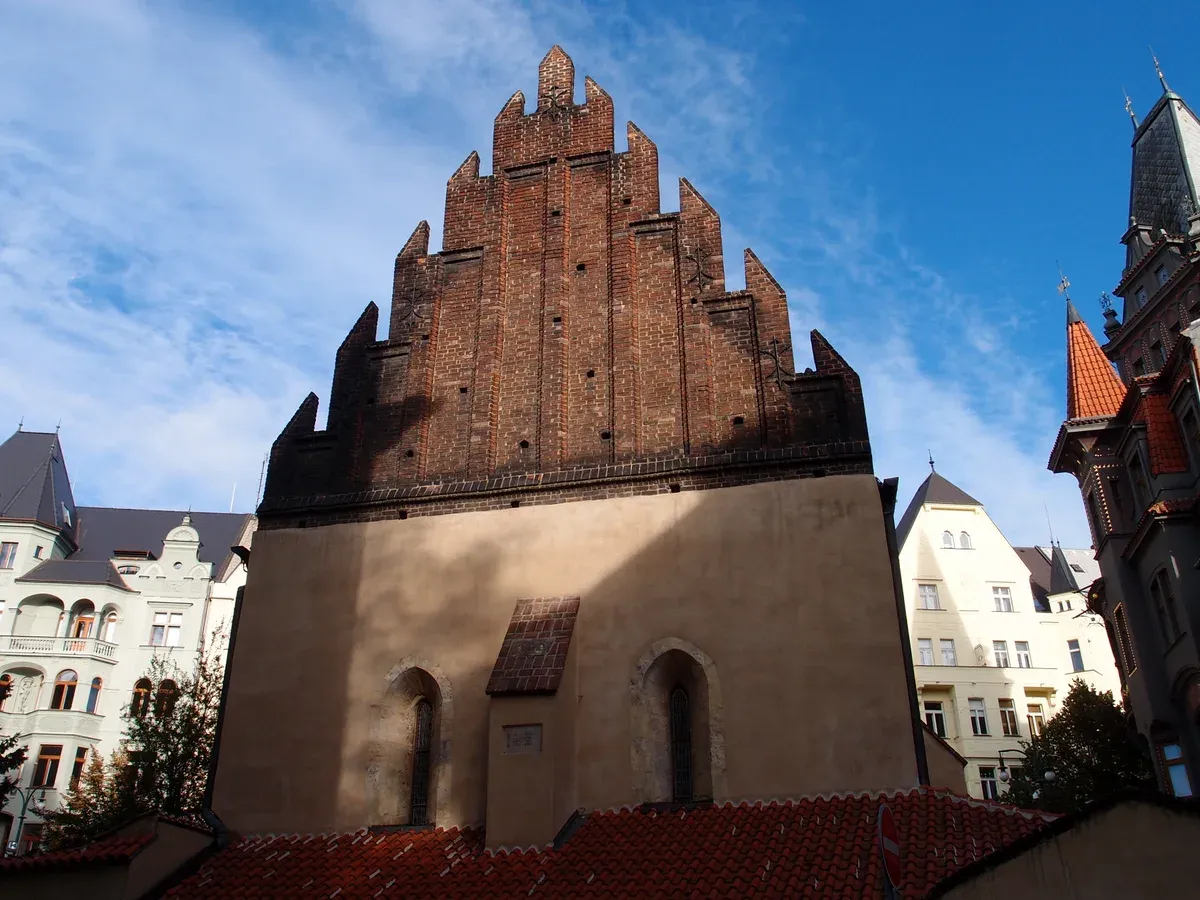
The Old New Synagogue, a short walk from the cemetery. Photo: Paljan84, CC BY-SA 3.0, via Wikimedia Commons
The Cemetery After Dark on a Ghost Walk
You cannot go inside the cemetery at night. It closes with the museum, and the ghost walks that reach it stop at the wall, which is exactly where the best stories live.
Tours That Finish at the Wall
One of the bookable ghost walks ends at the cemetery. Prague Ghosts and Legends Nighttime Guided Walking Tour by Mysterium Tours costs $21, runs 100 minutes to 2 hours and is rated 4.7 from 1,775 reviews. Its route runs from Old Town Square through the Church of Our Lady before Týn, the Týn yard at Ungelt, a secret stop, past the Old-New Synagogue, a second secret stop, and finishes at the Old Jewish Cemetery. A costumed storyteller guides in English, German or Italian, and free cancellation applies up to 24 hours.
Nothing is entered on this tour. Entry to buildings is not included, so the finish at the cemetery means standing at the wall after dark, not walking among the graves.
| Tour | Price | Duration | Cemetery at night |
|---|---|---|---|
| Prague Ghosts and Legends Nighttime Guided Walking Tour | $21 | 100 minutes - 2 hours | Finish at the cemetery, exterior only |
| Prague Ghost Tour with a Costumed Storyteller | $25 | 1.5 hours | Passes the cemetery, exterior only |
Tours That Pass By
Prague Ghost Tour with a Costumed Storyteller by Prague Articulate lists the Old-New Synagogue and the Old Jewish Cemetery on its route, with the Astronomical Clock as the last stop. It costs $25, lasts 1.5 hours and runs in English from the Old Town Hall on Old Town Square. The guide wears early 1900s costume, entrance into buildings is not included and there are no jump scares. The ticket does not cover entry to the cemetery. To walk among the tombstones you need the Jewish Museum circuit ticket described above, bought in daylight hours.
The lantern route of Prague Ghosts, Legends, Medieval Underground and Dungeon Tour runs through former Jewish Ghetto lanes for $30.92 and passes an abandoned forgotten cemetery on its route, but this is not the Old Jewish Cemetery and no entry to it is claimed. If you want Rabbi Loew and the Golem story told properly, that legend has its own page at Golem of Prague, covering the attic of the Old New Synagogue where the legend says the clay body waits.
Why Night Visits Are Not Possible
The cemetery keeps museum hours and is closed at night, and Jewish law is the reason behind the care taken here. Custom forbids disturbing graves, which is why the community stacked layers of soil instead of clearing old ones, lifting old stones back on top. Even in summer, when the museum runs 9:00 to 19:00 from 1 May to 31 August, ticket sales end 30 minutes before closing, and the evening walks pass the cemetery after the gates have shut.
Seeing the wall by night with a storyteller is a different experience from the daylight visit, and doing both is the honest answer for anyone who wants the full picture.
Around the Cemetery in Josefov
The cemetery sits at the center of the six surviving synagogues of the old Jewish Quarter. Your circuit ticket covers most of them, and the area rewards a slow loop.
The Synagogues on Your Ticket
Most of the old Jewish quarter was demolished between 1893 and 1913, leaving six synagogues, the old cemetery and the Jewish Town Hall. Start at the Pinkas Synagogue at Široká 3, completed in 1535 and founded by Aaron Meshullam Horowitz. Its walls carry about 80,000 names of Jewish victims from Bohemia and Moravia, and an upper floor shows children's drawings from Terezín, about 4,500 of which survive in the Jewish Museum collection.
The Klausen Synagogue at U Starého hřbitova 3a is the largest surviving synagogue of the former ghetto, rebuilt in baroque style in 1694 after small prayer houses burned in the 1689 ghetto fire, and it shows Hebrew manuscripts and exhibits on Jewish festivals. The neighbouring Ceremonial Hall continues the exhibition on the end of life. The Maisel Synagogue at Maiselova 10 covers Jewish history in Bohemia and Moravia from the 10th to the 18th century, and a replica of Šaloun's Rabbi Loew statue dated 1914 stands inside it.
The Spanish Synagogue at Vězeňská 1, built in 1868, has a Moorish Revival interior with gilding and stained glass.
The Old New Synagogue and Rabbi Loew
The Old New Synagogue was completed in 1270 and is Europe's oldest active synagogue. Its twelve narrow Gothic windows are said to stand for the twelve tribes of Israel, and visitors can see the seat where Rabbi Loew traditionally sat. Legend credits angels turned into doves with sparing it in the 1558 ghetto fire. The attic is not open to the public. The lowest three metres of the outside stairs were removed, the attic door sits about twelve metres above ground, and an 1883 renovation, a 1920 climb and an August 2014 exploration found no trace of a golem. The Golem legend itself is told on Golem of Prague.
For the man himself, Šaloun's Rabbi Loew statue sits in a recess on the main facade of the New Town Hall on Mariánské náměstí, built 1909 to 1911 by architect Osvald Polívka. The statue is 6 metres high including its pedestal and the stone figure alone measures 360 cm. Šaloun chose Rabbi Loew to symbolise the whole Jewish Quarter instead of the usual allegorical figures, showing a nude young girl holding out a rose whose scent brings about the rabbi's death.
Book the Entry Ticket Ahead
Seeing these places by day means buying the entry yourself. The official adult price comes from each site's own price list, and the booking link opens a dated e-ticket.
Ticket
The table sets each sight's official adult price beside a link to book the entry online. Reduced and family rates still apply at the gate where the site offers them, so check them before you pay.
| Sight | Official adult price | Book |
|---|---|---|
| Jewish Museum circuit, with the Old Jewish Cemetery | 600 CZK adult | Book the ticket |
Frequently Asked Questions
Can you visit the Old Jewish Cemetery in Prague?
Yes, on the Jewish Museum circuit ticket. Adult admission is 600 CZK, students under 26 pay 400 CZK and children 7 to 15 pay 200 CZK, and the ticket covers four synagogues plus the cemetery for 3 opening days. See the full breakdown in how to visit.
Can you visit the Old Jewish Cemetery at night or on a ghost tour?
No. The cemetery keeps museum hours, closes on Saturdays and Jewish holidays, and is closed at night. The nighttime ghost walk that finishes there stops at the wall, and no tour includes entry to the graves.
Where is the entrance to the Old Jewish Cemetery?
The entrance is at Široká 3, Prague 1, inside the Pinkas Synagogue building. More detail is in how to visit.
Is the Old Jewish Cemetery the oldest Jewish cemetery in the world?
Nothing in the Jewish Museum or Wikipedia material calls it the oldest Jewish cemetery in the world. What is stated is that the cemetery in Josefov dates from the first half of the 15th century, with its oldest gravestone dated 1439, as covered in the history section.
How long do you need for the Old Jewish Cemetery and Josefov?
The Jewish Museum says the cemetery alone takes about 30 minutes, while the full circuit ticket takes 2 to 3 hours to cover the synagogues and the cemetery. Plan the timing with the seasonal hours in how to visit.
Why are the tombstones in the Old Jewish Cemetery so crowded?
Jewish custom forbids disturbing graves, so when space ran out the community added layers of soil and set the old stones back on top. The sources describe up to twelve layers, though the Jewish Museum's own page says up to ten, which is explained in the history section.