 Ghost Tour Prague
Golden Lane Prague: The Castle's Little Painted Street
Golden Lane in Prague is a narrow street of small painted houses built into the outer wall of Prague Castle, and this guide covers what it actually is, who really lived there, and how tickets work. The alchemist story is mostly myth. Rudolf II's alchemists worked elsewhere in the castle area, not in these cottages. The real residents were castle guards, goldsmiths, a fortune teller and, through his sister's rental, Franz Kafka, who wrote there for about a year. Below you get the history, the Daliborka tower legend at the end of the lane, the ticket options with figures, and the evening walks that pass it after dark. For the deeper alchemy sites in the Old Town, see Speculum Alchemiae. The bookable tours are compared on ghost tour in Prague.
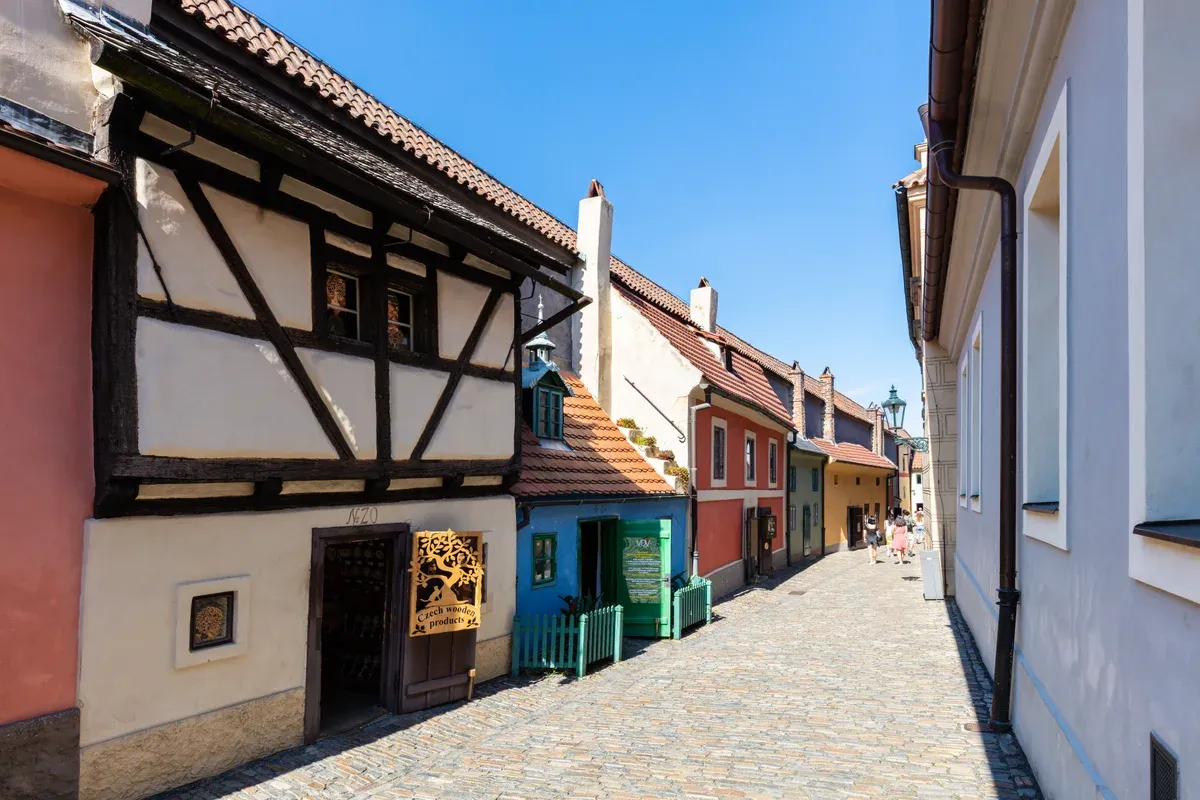
Golden Lane at Prague Castle. Photo: Diego Delso, CC BY-SA 4.0, via Wikimedia Commons
Quick answer Golden Lane at a glance
Golden Lane Prague is a 16th century street of tiny houses built into the arches of Prague Castle's northern wall, entered with a castle circuit ticket that costs 450 CZK for adults on the Main Circuit. The lane was built in the 16th century to house Rudolf II's castle guards and got its name from the goldsmiths who moved in during the 1600s. The alchemist legend is just that: the alchemists lived elsewhere in the castle area. Kafka wrote at No. 22 in 1916.
Key takeaways
- The lane sits between the White Tower and Daliborka tower at Prague Castle, and nine of its sixteen houses hold small exhibitions. Details in what Golden Lane is.
- The residents were guards, goldsmiths and writers, not alchemists. See who really lived there.
- To see Golden Lane at night with the alchemy stories, the pick is Alchemy and Mysteries of Prague Castle Walking Tour at $32.07, exterior only.
- A cheaper 90 minute option in the castle district is Mysteries and Alchemy at Prague Castle Myths and Legends at $20.61, with the tram ticket included.
What Golden Lane Is
A street of very small houses grown out of a castle wall, older than it looks and smaller than most visitors expect.
Houses Built Into the Wall
The little houses were built into the arches of the northern fortification of Prague Castle around 1500. The lane sits in the northern part of the castle grounds, between the White Tower at one end and the Daliborka tower at the other, and it connects directly to Daliborka, which was a prison. Aview on Cities counts 24 wooden houses in the original lane. Whole families lived in cottages that today feel cramped for one shop.
The lane changed shape over the centuries. One side was demolished in the 19th century as unfit for living. The pastel colours people photograph now date from a repaint between 1952 and 1955, and the lane has looked that way since 1955. A further reconstruction ran in 2010 and 2011 according to prague.eu. Today the lane holds craft souvenir shops, a café, and a defensive corridor with knight armour.
What You See Inside Today
Sixteen houses survive on the lane and nine of them hold permanent exhibitions on five centuries of life in the lane. Each shows a slice of how the tiny spaces were used, from workshops to family rooms. A restored 14th century fortification reached from the lane holds a medieval armoury exhibition, so the wall that generated the houses is itself part of the visit.
The interior visit is what the paid ticket buys. Castle buildings open 9:00 to 16:00 from November to March and 9:00 to 17:00 from April to October, on the hours prague.eu lists. Outside those hours the lane itself stays walkable: prague.eu says evening access to Golden Lane is free after the paid hours, but the houses cannot be entered, and Wikipedia says the same, though one other guide says free access is unavailable, so confirm on site. The castle grounds are open 6:00 to 22:00 and the castle closes on 24 December. If you want the lane at night with stories attached, Alchemy and Mysteries of Prague Castle Walking Tour walks it as an exterior stop over 3 hours for $32.07.
Sources: prague.eu on Golden Lane, Aview on Cities, Wikipedia
Who Really Lived on Golden Lane
The lane's actual resident list is guards, craftsmen and writers. It is good history even without the alchemists, and the table below collects the documented names from prague.eu, Wikipedia and Aview on Cities.
The Documented Residents
Prague.eu lists red shooters, the castle guards, along with goldsmiths, herbalists and the fortune teller Matylda Průšová among the lane's residents. The most famous name is Franz Kafka. His sister rented house No. 22 in 1916 and Kafka wrote there for about a year. A plaque marks the house today. The poet Jaroslav Seifert, who won the Nobel Prize in 1984, lived in the lane, and prague.eu says writers including František Halas and Seifert gathered in house No. 12.
Matylda Průšová, the fortune teller, lived at No. 14 before the Second World War.
| House or resident | When | What they did |
|---|---|---|
| Castle guards (red shooters) | 16th century onward | First residents, the lane was first called the archers' lane |
| Goldsmiths | 17th century | Worked and lived on the lane and gave it its name |
| Herbalists | not stated | Listed by prague.eu among the lane's trades |
| Matylda Průšová, No. 14 | Before the Second World War | Fortune teller |
| Franz Kafka, No. 22 | 1916, about a year | Wrote here while his sister rented the house |
| Jaroslav Seifert and František Halas, No. 12 | Seifert lived in the lane, writers gathered in No. 12 | Writers, Seifert later Nobel laureate |
Why Is It Called Golden Lane
The name has a boring, honest answer. The lane took its name from the goldsmiths who lived and worked there in the 17th century. Before that it was called Goldsmiths' Lane, Zlatnická, and before that the archers' lane, because the castle guards lived there.
No gold dust, no emperor's secret, just the trade on the street sign.
- Archers' lane: the first name, after the guards
- Goldsmiths' Lane (Zlatnická): the trade name
- Zlatá ulička, Golden Lane: the name that stuck
The Alchemist Myth
Many visitors arrive believing alchemists once huddled in these cottages boiling potions for Rudolf II. The sources say otherwise. Rudolf II moved his court to Prague in 1583, brought alchemists including Edward Kelley and John Dee to his court and kept a private laboratory. But the alchemists of Rudolf II lived elsewhere in the castle area and not on Golden Lane, as Aview on Cities puts it plainly. The nearest thing to a real alchemy site inside the castle is Mihulka, the Powder Tower, where hrad.cz says an alchemist's laboratory was located in Rudolf II's time, and which later served as a gunpowder store until 1754 and as a dungeon.
The myth sells well, so evening walks trade on it. Alchemy and Mysteries of Prague Castle Walking Tour covers Rudolf II, alchemy and the Golem around the castle and the Golden Lane for $32.07 over 3 hours, and its listing is honest that no interiors are entered. For actual alchemy rooms you can stand in, the Old Town has Speculum Alchemiae, a real excavated laboratory at Haštalská 1 with 30 minute guided tours daily 10:00 to 18:00, and the Museum of Alchemists and Magicians of Old Prague at Jánský vršek 8 in Malá Strana, open daily 10:00 to 20:00.
Sources: prague.eu, Wikipedia, prague.org, Aview on Cities, hrad.cz on Mihulka
Daliborka Tower and Its Legend
Golden Lane ends at a round prison tower, and the tower has a story of its own.
A Prison From 1496
Daliborka stands at the far end of Golden Lane, built in 1496 on the slope of the Deer Moat under Vladislav II by the architect Benedikt Ried. It worked as a prison until 1781. The tower has four basement cells and an oubliette that was reached by a pulley, so prisoners were lowered in and had no stairs back out.
The White Tower and Mihulka, the other towers near the lane, also served as prisons.
Dalibor and His Violin
The tower is named after its first prisoner, Dalibor of Kozojedy, jailed in 1498 for sheltering rebelling serfs. The story says he learned to play the violin in his cell, that Prague people gathered below to listen, and that they lowered food to him in a basket. Prague.eu points out the anachronism: violins reached Bohemia about a hundred years after Dalibor died.
The site suggests the legend grew from an older saying that necessity taught Dalibor to sing, meaning torture drew a confession from him. Bedřich Smetana turned the story into the opera Dalibor, which premiered in 1868. Daliborka was covered by the older Circuit B ticket along with the lane, so check the castle's price list for what your ticket opens today.
Sources: prague.eu on Daliborka, Czech Radio
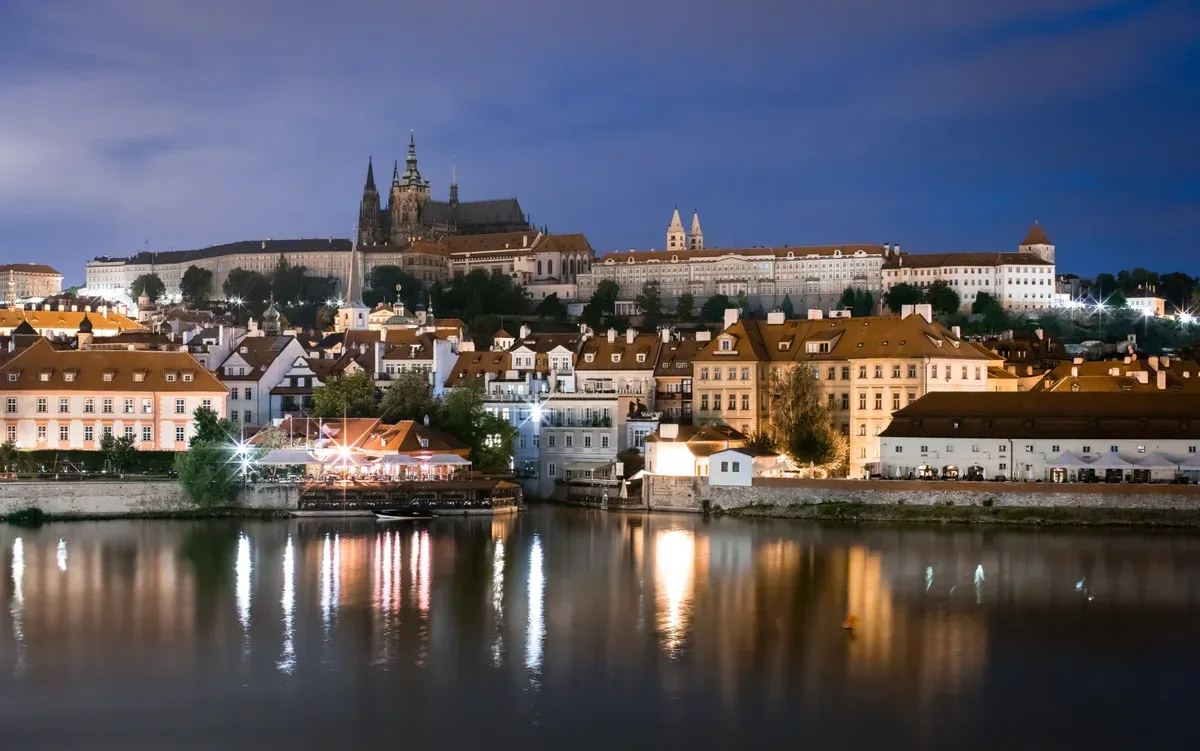
Prague Castle at night. Photo: Lucas Garron, CC0, via Wikimedia Commons
Tickets, Hours and the Evening
Golden Lane sits inside the paid Prague Castle circuit, and the ticket rules matter more here than at most sights.
Ticket Prices at a Glance
The rows below give the castle's own admission figures and the reported older Circuit B price.
| Ticket | Price | Includes Golden Lane |
|---|---|---|
| Prague Castle Main Circuit (adult) | 450 CZK | Yes, houses and exhibitions |
| Main Circuit (discounted 6-16, students to 26, 65+) | 300 CZK | Yes |
| Main Circuit (family, 1-5 children under 16) | 950 CZK | Yes |
| Reported older Circuit B (adult) | 250 CZK | Yes, with Daliborka and St Vitus |
| Children under 6 | Free | Yes |
| Golden Lane after paid hours (reported, confirm on site) (reported, confirm on site) (reported, confirm on site) | Free | Walk through only, houses closed |
Which Ticket Covers the Lane
The lane is part of the Prague Castle Main Circuit, which also includes the Old Royal Palace, St George's Basilica and St Vitus Cathedral. The hrad.cz price list valid from 1 March 2024 gives it at 450 CZK for adults, 300 CZK discounted and 950 CZK for a family. The discount applies to youth aged 6 to 16, students up to 26 and adults 65 and older, and the family ticket covers one to five children under 16 with a maximum of two adults.
Children under 6 enter free. A reported older Circuit B ticket covering the lane, Daliborka and St Vitus cost 250 CZK for adults, and some third-party guides still quote that figure, so the official list may have been revised. The Prague Visitor Pass also lists the lane at 450 CZK, free with the pass.
The Table of Tickets
These are the castle admission figures from the hrad.cz price list and the reported Circuit B figure, so you can see what each option costs and whether it opens the lane's houses.
Rules Worth Knowing Before You Queue
Prague Castle tickets are valid for two days and each building can be entered only once, so plan the lane for one of those days. Tickets cannot be refunded. An audioguide costs 350 CZK for 3 hours plus a 500 CZK deposit, and a guided tour with a castle guide costs 250 CZK per person per hour.
Nine of the sixteen houses hold permanent exhibitions on five centuries of life in the lane, and there is also a craft souvenir shop, a café and a defensive corridor with knight armour, plus a medieval armoury exhibition in a restored 14th century fortification reached from the lane.
Hours and the Evening Rule
Prague.eu gives castle building hours of 9:00 to 16:00 from November to March and 9:00 to 17:00 from April to October, while the castle grounds stay open 6:00 to 22:00 and the castle closes on 24 December. Prague.eu and Wikipedia both say the lane is free to walk through after the paid hours, but the houses cannot then be entered, and one other guide contradicts that, so treat the free evening walk as likely but confirm on site. Sources: hrad.cz price list, prague.eu
Golden Lane on a Night Alchemy Tour
If the houses are shut, a night walk is the other way to see the lane, and three alchemy tours pass through or near the castle.
The Tour That Names the Lane
The Alchemy and Mysteries of Prague Castle Walking Tour is a 3 hour evening walk that routes through the Golden Lane and the castle grounds, with stories of Rudolf II, alchemy, the Golem and the Devil's Bible. It costs $32.07 and takes up to 30 people in English or German. Be clear about what the money buys: the listing states entry is not included, so this is an exterior walk and you do not go inside the houses.
Children up to 6 join free, and it meets in front of the house at Týnská 627/7 behind Týn Church.
The Castle District Alternative
Mysteries and Alchemy at Prague Castle Myths and Legends costs $20.61, runs 90 minutes and starts with a tram ride up to the castle and covers about 2.8 km, led by a guide in a gothic outfit with a lantern. It meets at the Pohořelec tram stop in front of the statue of Tycho Brahe and Johannes Kepler. Interiors are not included, so again you see the castle area from outside.
The Malá Strana Alchemy Walk
The Prague Alchemy Legends and Mysteries Walking Tour costs $20.61 and lasts 105 minutes through Nový Svět and Malá Strana, passing Tycho Brahe's residence and Edward Kelley's alchemy laboratory tower. It stays in the streets below the castle rather than on the lane itself, and the price includes a 30-minute public transport ticket. If you want the lane's interiors, buy the castle circuit ticket by day.
If you want the legends after dark, one of these three walks does that job, and none of them replaces the ticket.
Book the Entry Ticket Ahead
Seeing these places by day means buying the entry yourself. The official adult price comes from each site's own price list, and the booking link opens a dated e-ticket.
Ticket
The table sets each sight's official adult price beside a link to book the entry online. Reduced and family rates still apply at the gate where the site offers them, so check them before you pay.
| Sight | Official adult price | Book |
|---|---|---|
| Prague Castle main circuit, with Golden Lane | 450 CZK adult | Book the ticket |
Golden Lane FAQ
Why is it called Golden Lane?
The lane took its name from the goldsmiths who lived there in the 17th century, and it was once called Goldsmiths' Lane (Zlatnická) before becoming Zlatá ulička. Before that it was the archers' lane, because the first houses built into the castle's northern wall held the castle guards. The alchemists lived elsewhere in the castle area and not on the lane.
Is Golden Lane included in the Prague Castle ticket?
Yes, the lane is part of the Prague Castle Main Circuit, which costs 450 CZK for adults, 300 CZK discounted and 950 CZK for a family on the hrad.cz price list valid from 1 March 2024. The ticket also covers the Old Royal Palace, St George's Basilica and St Vitus Cathedral, is valid two days, and cannot be refunded. See the ticket table above for the full breakdown.
Can you walk Golden Lane for free in the evening?
Prague.eu and Wikipedia both say the lane is free to walk through after the paid hours, but the houses cannot then be entered, and one guide contradicts this, so confirm on site. The castle grounds are open 6:00 to 22:00 and the castle buildings run 9:00 to 17:00 from April to October and 9:00 to 16:00 from November to March, closed 24 December.
Did Kafka live on Golden Lane?
Kafka's sister rented house No. 22 in 1916 and Kafka wrote there for about a year, and a plaque marks the house today. A night look at the lane itself is possible on the Alchemy and Mysteries of Prague Castle Walking Tour, which passes through it after dark.
Did the alchemists of Rudolf II live on Golden Lane?
No. The alchemists of Rudolf II lived elsewhere in the castle area and not on the lane, which is the myth part of the story. The houses held castle guards, then goldsmiths, herbalists and the fortune teller Matylda Průšová, who lived at No. 14 before the Second World War. An alchemist's laboratory stood in the Mihulka tower in Rudolf II's time. The Alchemy and Mysteries of Prague Castle Walking Tour covers the castle alchemy stories.
What is the Daliborka tower at the end of Golden Lane?
Daliborka is a prison tower built in 1496 by Benedikt Ried and used as a prison until 1781, with four basement cells and an oubliette reached by a pulley. It is named after its first prisoner, Dalibor of Kozojedy, jailed in 1498, and the legend says he played the violin in his cell while Prague people lowered food to him. Smetana made the story into the opera Dalibor, which premiered in 1868.